


Albert Deak Space Time, Quantum Metaphysics and Human Consciousness

Albert Deak builds images like visual thought experiments. His paintings don’t sit still. They split, echo, fade, return, and ask a hard question: what does consciousness look like when it moves through time?
That question runs through his work as an international contemporary visual artist, painter, and ceramic designer. Deak’s practice bridges fine art, quantum physics, philosophy, sacred imagery, and future technology. His official portfolio platform, albertdeak-visualartist.com, presents a body of work that has gained attention across international art publications and contemporary art contexts.

The Visionary Universe of Albert Deak
Albert Deak works from a rare position. He treats painting as a place where scientific imagination and metaphysical inquiry can meet without cancelling each other out.
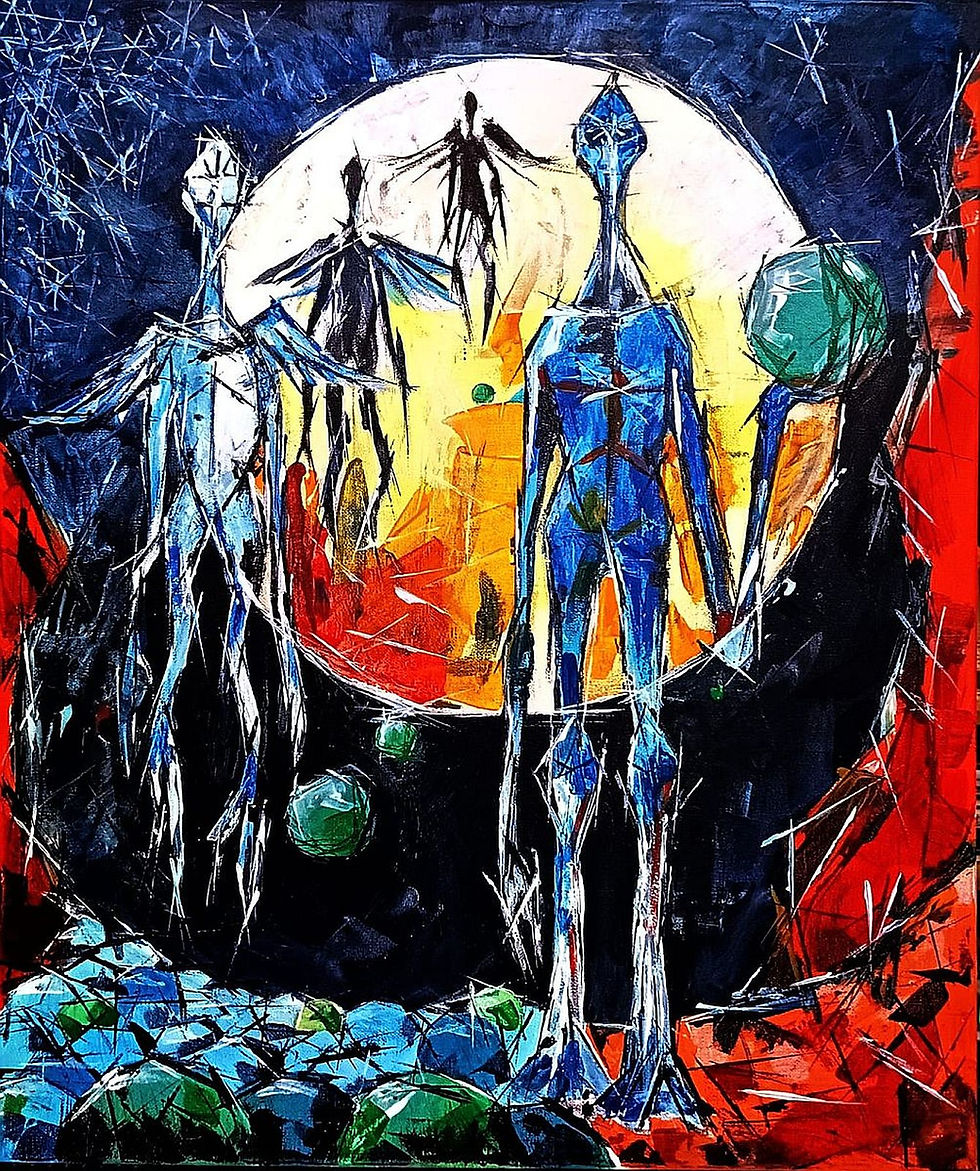
His art is not an illustration of physics. It is not a diagram. It is a visual philosophy. Deak uses the language of space, energy, refraction, movement, and repetition to explore how reality may be perceived by a mind that is never fixed in one moment.
At the centre of this practice sits a group of clear concerns:
space-time curvature
Heisenberg’s uncertainty principle
metempsychosis, or the rebirth and journey of consciousness
decision paths and branching realities
the dialogue between biological intelligence and artificial systems
the survival of sacred symbols in technological culture
These are large ideas. Deak gives them visual pressure. He makes them visible through forms that appear, disappear, fracture, and return.
Einstein’s general theory of relativity changed how modern culture thinks about space and time. Space is not a blank container. Time is not a detached clock. Both belong to a single structure shaped by mass, energy, and motion. Deak translates that idea into painted space. His compositions often feel curved, layered, and gravitational. The eye doesn’t move across a flat surface in a straight line. It bends.
Heisenberg’s uncertainty principle, first formulated in 1927, states that certain pairs of physical properties, such as position and momentum, cannot both be known with perfect precision at the same time. Deak turns that scientific limit into an artistic method. His figures resist final definition. A form may be a body, a trace, a wave, a reflection, or the memory of a body that has already passed.
That ambiguity matters. It gives the work its force.
As an Albert Deak visual artist profile shows, his paintings press beyond surface detail. They ask how perception behaves under pressure. What happens when memory, prediction, identity, and belief occupy the same visual field?
Metempsychosis adds another layer. The term refers to the transmigration or rebirth of the soul. In Deak’s work, it doesn’t appear as a closed religious doctrine. It becomes a visual model for continuity. A human shape may leave one panel and return altered in the next. A face may dissolve into light. A sacred icon may reappear as a spectral system of energy.
The self, in this universe, is never a fixed object. It is a passage.
Signature Style and Multi-Panel Architecture
Deak’s strongest works often use multi-panel architecture. Triptychs and tetraptychs are not just formats. They are engines of meaning.
A single canvas can hold an event. A triptych can hold a transformation. A tetraptych can hold a sequence, a contradiction, or a branching reality. Deak uses these structures to build continuous visual shifts across separate surfaces.
This matters because the gaps between panels become part of the work. They act like pauses in thought. They create jumps in time. They ask the viewer to complete what the painting withholds.
In a Deak triptych, one form may begin as a solid figure, then turn translucent, then return as light. In a tetraptych, the same motif can pass through four states:
Solid presence | Partial disappearance | Spectral echo | Radiant afterimage |
Body | Transition | Memory | Energy |
This is where Deak’s visual intelligence becomes clear. He doesn’t just repeat imagery. He changes its state.
His Abstract Reform technique gives structure to uncertainty
Deak describes a method often associated with his practice as “Abstract Reform”. The phrase fits because his work reforms abstraction rather than using it as pure gesture.
The technique combines:
traditional acrylic painting
textured gesso relief
carefully built surface tension
precise graphic layers
digital precision translated back into painterly space
The result is neither purely hand-made nor purely digital in feeling. It carries both impulses. The gesso creates physical depth. Acrylic colour gives heat and movement. The graphic layers create order, interruption, and coded rhythm.
This approach suits his subjects. A painting about space-time, consciousness, and artificial systems can’t rely only on expressive brushwork. It needs structure. It needs a visible logic. Deak’s surfaces often balance touch and calculation.
The hand remains present. So does the system.
Solid forms, ghosts, and light reflections shape time
One of Deak’s most distinctive visual devices is the shifting status of form. A figure or object may appear in three states at once:
as a solid painted presence
as a translucent “ghost”
as a radiant reflection or trace of light
This device lets him show time without narrating it. A ghost form can suggest the past. A radiant form can suggest prescience, or the sense of a future already pressing into the present. A blurred or displaced form can suggest a Doppler shift, the change in perceived frequency caused by motion.
The Doppler effect is most familiar in sound, such as the pitch change of a passing siren. Deak adapts the concept visually. His images can feel as if a figure or signal is moving past the viewer at speed. The image stretches, slips, and alters. Colour behaves like motion.
That creates temporal memory. The painting holds not one instant, but several.
This is why his multi-panel works feel closer to mapped experience than fixed composition. They don’t simply show a subject. They track a subject’s passage through perception.

Key Conceptual Themes
Deak’s work can be read through several major themes. They often overlap. That overlap is part of the point. His paintings treat reality as a layered field, not a single scene.
For readers following contemporary metaphysical art, space time painting, quantum physics in fine art, the work of an abstract triptych artist, and Albert Deak artworks, these themes offer a useful framework.
The Chronoplane and space-time
The Chronoplane is one of the richest ideas in Deak’s visual world. It can be understood as a painted plane where time, choice, and space intersect.
In everyday life, time feels linear. One action follows another. One decision closes a door and opens another. Deak complicates that model. His paintings suggest that decisions leave visible structures, like branches, echoes, or alternate pathways.
This idea connects with modern discussions of multidimensionality. In physics and cosmology, branching models appear in many forms, from speculative theories of multiple worlds to the visual mapping of probabilities. Deak doesn’t claim to prove such systems. He uses their imaginative force.
His Chronoplane works often present:
branching lines that resemble decision paths
geometric fields that imply cosmic architecture
distorted grids that resist stable perspective
figures placed between visible and invisible states
colour shifts that mark different densities of time
The result is a visual space where causality becomes visible. A decision does not disappear after it is made. It leaves a trace. It bends the field.
This is one reason his paintings reward slow looking. At first, they may appear abstract. Then the structure begins to emerge. A line isn’t only a line. It may be a path. A glow isn’t only colour. It may be a threshold. A figure isn’t only a body. It may be consciousness moving from one state to another.
Deak’s Chronoplane imagery also has a strong curatorial appeal because it links painting to ideas often handled by science fiction, theoretical physics, and philosophy. Yet the work stays grounded in the material traditions of studio practice.
Canvas, acrylic, gesso, ceramic thinking, and composition all remain vital.
Reinterpreting sacred icons
Deak also reworks sacred and canonical imagery. His conceptual reinterpretations of Salvator Mundi offer a clear example.
The original iconography of Salvator Mundi, meaning “Saviour of the World”, places a blessing figure at the centre of cosmic order. One hand blesses. The other holds a globe. The image carries authority, divinity, and universal reach.
Deak does not simply quote this tradition. He transforms it.
In his reinterpretations, sacred presence may become spectral energy. The human form may become humanoid rather than human. The globe may become a cosmic field, a glowing system, or a coded sphere. The icon is no longer only a devotional image. It becomes a question about intelligence, energy, and perception.
This is not a rejection of the sacred. It is a re-siting of it.
Deak asks what sacred imagery means after modern physics, after space exploration, after artificial intelligence, and after digital culture changed how images circulate. A halo can become a field of radiation. A blessing can become a signal. A face can become an interface between the body and the unknown.
That movement from icon to energy is central to his work. It links Renaissance structure to future-facing metaphysics.
His use of humanoid forms is important here. A humanoid is close to human, but not identical. It carries recognition and distance at the same time. That tension fits the age of artificial systems. Human intelligence now meets machines that can imitate, extend, and challenge human perception.
Deak’s sacred figures often sit inside that tension. They don’t offer comfort. They ask what a soul, a body, or a divine image becomes when the world has learned to think in code, data, and cosmic scale.

Ancient signals and AI integration
Another major theme in Deak’s practice is the merging of ancient signals with future technology.
This includes paleocontact symbolism, ancient codes, archaic markings, and speculative narratives about intelligence beyond the present human frame. Paleocontact ideas refer to theories and myths about contact between ancient cultures and non-human or advanced beings. In art, these ideas often function less as claims and more as symbols. They let artists think about memory, origin, myth, and the unknown.
Deak brings this material into contact with artificial intelligence.
That pairing is powerful. Ancient signs and machine intelligence sit at opposite ends of human history. One points back to caves, temples, stone marks, ritual objects, and lost systems of meaning. The other points towards prediction, simulation, generated imagery, and non-biological forms of analysis.
Deak places both in the same visual field.
A painted mark can feel ancient and digital at the same time. A line may resemble a carved code, then shift into a network. A humanoid form may read as ancestor, visitor, machine, or reborn consciousness. The ambiguity is controlled. It is part of his method.
His ceramic design background strengthens this theme. Ceramics carry some of the oldest artistic associations in human culture. Clay records touch, pressure, heat, and survival. When a painter with ceramic sensitivity approaches futuristic imagery, the result gains weight. The future does not float free from the past. It has matter.
This is one of Deak’s most useful contributions to contemporary art’s conversation about technology. He avoids treating artificial intelligence as a detached novelty. He places it inside a much longer history of marks, myths, rituals, tools, and symbolic systems.
That gives the work depth. It asks whether artificial systems are a break from human history or a new chapter in an old story: the desire to extend mind beyond the body.
The Philosophical Imperative
Deak’s core thesis is direct: visual art can model the evolution of consciousness.
That is a serious claim. It means painting can do more than represent an object, mood, or scene. It can become a way of thinking through existence. It can test how identity moves through time, how memory reshapes form, and how perception changes under the pressure of science and technology.
His art stands at the meeting point of several questions:
What remains human when intelligence becomes partly artificial?
Can a sacred image survive as light, code, or energy?
Does consciousness follow a line, or does it branch?
Can painting describe time without turning into illustration?
Can matter hold metaphysical thought?
Deak’s answer is visual. He builds works that refuse a single reading. A panel may act as a moment. A triptych may act as a sequence. A tetraptych may act as a field of possible futures.
The philosophical strength of this practice comes from its refusal to separate old and new. Deak places religious image history, quantum thought, cosmic geometry, and artificial intelligence inside one visual grammar. He doesn’t treat them as competing worlds. He treats them as evidence of the same human drive: to map what can’t be fully known.
That is where Heisenberg’s uncertainty principle becomes more than a scientific reference. It becomes an ethical and aesthetic position. The world cannot always be pinned down. The self cannot always be fixed. The future cannot always be measured before it arrives.
Art can hold that uncertainty without reducing it.
Why Albert Deak’s Work Matters Now
Contemporary art has no shortage of images about technology. Many stop at surface effects. Screens, glitches, digital patterns, and machine aesthetics can look current without asking much.
Deak’s work goes further because it connects future technology to metaphysics. He asks what technology does to the idea of the soul, the icon, memory, and destiny. That gives his practice a sharper place in current visual culture.
His paintings also matter because they defend complexity without becoming obscure. The viewer does not need a physics degree to feel the work. The visual cues are clear enough: light, motion, doubling, curvature, fragmentation, and return. The deeper references reward research, but the first encounter remains sensory.
For curators, that balance is valuable. The work can sit in conversations about abstraction, post-digital image culture, spiritual modernism, speculative futures, and the revival of metaphysical painting. For collectors, the appeal lies in the tension between visual beauty and intellectual architecture. These are works that ask to be lived with, not merely viewed once.
Deak’s use of multi-panel structure also places him in a long art historical line. Religious altarpieces used panels to stage sacred time. Modern abstraction used panels to test rhythm, sequence, and scale. Deak brings both histories into a contemporary frame and adds physics, artificial intelligence, and consciousness studies.

That combination gives his work its particular charge.
Albert Deak’s universe is not decorative space. It is thinking space. It treats the canvas as a Chronoplane, a zone where matter, memory, myth, and future intelligence meet. His figures shimmer because they are not finished becoming. His icons dissolve because they are entering another order. His panels branch because consciousness branches.
The takeaway is clear. Deak’s art does not ask whether painting can survive in an age of advanced technology. It shows why painting still matters. A screen can process an image. A painting can hold uncertainty, belief, time, and touch in the same field. That remains powerful.
Comments