



Artistic Synthesis: How Hybrid Forms Generate New Visual Meaning

Art rarely advances by purity. It gathers, alters, absorbs, and recomposes. A painting may carry the memory of architecture, ceremony, theatre, theology, photography, migration, and touch. A sculpture may speak through metal, fibre, archive, refuse, ritual, and digital code. What appears as a single image often holds many histories in tension.
Artistic synthesis names this generative condition. It is the process by which distinct elements meet and produce meaning that none of them could hold alone. Form joins material. Technique joins intention. A cultural sign leaves one setting and enters another. A gesture borrowed from the body becomes a mark on canvas. A technological image becomes a sacred echo, a political trace, or a new kind of ornament.
This matters because synthesis is one of art’s primary engines of visual intelligence. It allows artists to remake inherited languages rather than merely repeat them. It lets images cross borders, disturb categories, and expand the ways viewers read the visible world. In synthesis, art becomes less a stable object than a site of relation, where memory, matter, and perception are composed into new visual thought.

Synthesis begins where separate artistic forces converge
To define synthesis in art, it helps to move beyond the simple idea of combination. Not every mixture becomes synthesis. A collage of parts may remain decorative if its elements do not alter one another. Synthesis occurs when parts enter a deeper relation and generate a new structure of meaning.
Five forces usually meet in this process.
Form gives visible order. It includes line, scale, composition, rhythm, balance, and spatial relation. Form is never neutral. A centralised Renaissance composition suggests harmony and hierarchy. A fractured Cubist plane suggests simultaneity and instability. A dispersed installation suggests movement through thought rather than a fixed point of view.
Material introduces physical intelligence. Marble, pigment, bronze, glass, textile, soil, plastic, video, and sound all carry different histories. Material may evoke labour, trade, ritual, industry, ecology, or intimacy. A work made from discarded bottle tops, as in El Anatsui’s sculptural hangings, does not simply use metal. It activates histories of consumption, exchange, colonial trade, and textile memory.
Technique shapes how matter becomes image. Fresco, glazing, carving, casting, weaving, printing, coding, and assemblage each discipline the hand and the eye. Technique also carries lineage. To paint in oil in fifteenth-century Europe was to adopt a medium capable of new luminosity and detail. To build with found objects in the twentieth century was to question the older separation between art and ordinary life.
Intention gives direction to the convergence. The artist may seek devotion, critique, remembrance, abstraction, mourning, pleasure, or disruption. Intention does not fix meaning, but it organises the work’s field of possibility.
Cultural context frames the work’s legibility. A symbol does not mean the same thing everywhere. A technique moves differently when it crosses borders. An object displayed in a museum changes when removed from a shrine, studio, street, or home.
Synthesis happens when these forces become inseparable. The viewer cannot extract one without changing the work. In that condition, art becomes a semantic organism, made through relation.
Historical synthesis shaped the major languages of art
Art history is not a sequence of isolated styles. It is a record of syntheses that became powerful enough to define periods, schools, and movements. These syntheses often begin as experiments, then harden into canons, only to be unsettled again by later artists.
Renaissance composition joined science, theology, and human presence
Renaissance art offers one of the clearest examples of synthesis as structural order. Artists in fifteenth- and sixteenth-century Italy drew together classical antiquity, Christian theology, mathematical perspective, anatomical observation, and workshop technique. The result was not a simple recovery of the ancient past. It was a new visual system in which sacred and human worlds could occupy coherent space.
Masaccio’s frescoes in the Brancacci Chapel show this transformation with remarkable clarity. Bodies have weight. Architecture organises belief. Light behaves as though it belongs to the same world as the viewer. In Leonardo da Vinci’s The Last Supper, devotional narrative becomes a study in geometry, psychology, gesture, and temporal suspension. Christ sits at the vanishing point, but the drama unfolds outward through hands, faces, and waves of human response.
Raphael’s The School of Athens offers another synthesis. Philosophy, architectural imagination, classical revival, and papal ambition meet in a composition that turns thought itself into spatial order. The painting does more than depict thinkers. It proposes a world where knowledge is visible, balanced, and ceremonially staged.
Baroque drama fused bodies, light, and theatrical encounter
If Renaissance synthesis sought measured order, Baroque art intensified encounter. It drew painting, sculpture, architecture, theatre, devotion, and political spectacle into dramatic relation. Its spaces do not merely contain the viewer. They reach towards the viewer.
Caravaggio altered religious painting by merging sacred subjects with the physical immediacy of street life. His chiaroscuro does not function only as a technique of contrast. It becomes a spiritual instrument, cutting through darkness as revelation, danger, and judgement. In works such as The Calling of Saint Matthew, illumination is both physical and metaphysical. Light selects, exposes, and transforms.
Bernini extended synthesis into full spatial theatre. In the Cornaro Chapel, The Ecstasy of Saint Teresa joins marble, architecture, hidden light, painted illusion, and sculpted spectators into a single devotional event. The saint’s body, the angel’s gesture, the gilded rays, and the chapel’s architectural frame produce a staged vision in which sculpture becomes performance.
Rubens, too, synthesised motion, flesh, colour, diplomacy, and myth. His canvases are not only compositions. They are forces in motion, shaped by the politics and religious tensions of seventeenth-century Europe. Baroque synthesis made art into an event, where vision, emotion, and persuasion became inseparable.
Modernist abstraction transformed perception through fragmentation
Modernism did not abandon synthesis. It redirected it. Rather than unifying the visible world through perspective or theatrical drama, many modern artists asked how perception itself could be rebuilt.
Cubism, developed by Pablo Picasso and Georges Braque, synthesised African and Iberian sculptural references, Cézanne’s structural painting, modern urban experience, and shifting viewpoints. A Cubist still life does not merely fragment an object. It reorders seeing. Table, instrument, newspaper, figure, and space become interdependent planes. The image asks the viewer to assemble perception across time.
Kandinsky brought together music, colour theory, spiritual enquiry, and abstraction. His paintings sought a language beyond depiction, where line and colour might act with the force of inner sensation. Mondrian synthesised theosophy, urban rhythm, and formal reduction into grids of black lines and primary colours. Malevich’s Black Square compressed icon, void, surface, and metaphysical aspiration into one severe form.
Modernist abstraction often claimed purification, yet its achievements were deeply synthetic. It absorbed science, spirituality, technology, non-European art, industrial design, political utopia, and the shock of modern life. Its new visual grammar arose from many pressures at once.
Contemporary hybrid practice expands the field of the artwork
Contemporary art has made synthesis both method and subject. The artwork may now be an installation, database, performance, sound environment, social process, moving image, textile structure, archive, or architectural intervention. It may also be several of these at once.
Robert Rauschenberg’s Combines remain foundational in this history. By joining painting with found objects, photographs, fabric, and urban debris, he dissolved the boundary between pictorial space and lived environment. Nam June Paik synthesised television, sculpture, music, and performance, helping to make electronic media an artistic language rather than a technological novelty.
Doris Salcedo uses furniture, concrete, fabric, and architectural space to give form to absence and political grief. William Kentridge brings drawing, animation, theatre, opera, and historical memory into works that seem to think while they move. Wangechi Mutu combines collage, mythology, fashion imagery, botanical forms, violence, and speculative figuration to construct bodies that resist a single reading.
In these practices, synthesis does more than join media. It questions where an artwork begins, where it ends, and whose histories it can hold.
Materials, symbols, gestures, and technologies create new visual grammars
Every artistic synthesis invents some kind of grammar. This grammar may be formal, symbolic, bodily, technological, or all at once. It determines how the work speaks.
Material grammar begins with the physical qualities of the chosen medium. A rusted surface speaks differently from polished steel. Thread carries different associations from concrete. Clay retains pressure in a way that glass does not. Contemporary artists often select materials for their cultural charge as much as for their appearance.
El Anatsui’s monumental works, made from thousands of metal fragments linked with copper wire, sit between sculpture, textile, painting, and architecture. They shimmer like precious cloth yet derive from discarded materials. Their folds recall royal regalia, global trade routes, and the fragility of value. The work’s grammar depends on contradiction. It is heavy and fluid, broken and continuous, local and global.
Symbolic grammar emerges when images carry meanings across systems. A cross, mask, map, flag, flower, animal, or domestic object may enter a work with inherited associations. Once placed beside other signs, it changes. Shirin Neshat’s photographic and video works, for example, have brought together text, body, gendered space, political memory, and the black-and-white severity of photographic contrast. The written mark becomes both language and image. The body becomes both subject and contested field.
Gesture adds another grammar. A brushstroke may record speed, meditation, aggression, restraint, or ritual. In Abstract Expressionism, gesture became a sign of bodily presence and psychic intensity. In later performance and post-minimal practices, gesture could become repetitive, procedural, or collective. The mark no longer belonged only to the hand. It could belong to walking, breathing, measuring, repairing, or refusing.
Technology has altered visual grammar with particular force. Photography changed painting by redistributing the task of depiction. Film introduced montage, duration, and moving light. Video brought immediacy and feedback. Digital tools now allow artists to synthesise image, data, sound, artificial intelligence, scanning, and virtual space. Yet technology matters most when it becomes more than an effect. It becomes artistic when it reorganises thought, attention, and relation.

Cultural synthesis emerges through movement, exchange, and circulation
Cultural synthesis is one of art’s oldest and most contested conditions. Images, materials, motifs, and techniques have always travelled through trade, conquest, migration, pilgrimage, diplomacy, exile, and translation. These movements generate hybrid forms, but they also raise questions of power, ownership, and interpretation.
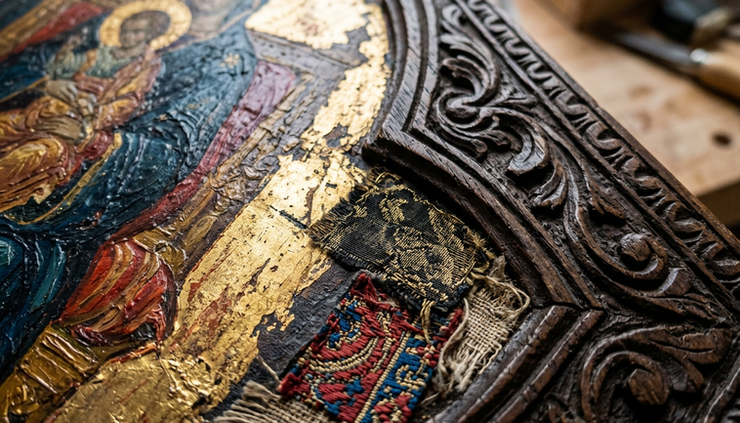
The history of Mediterranean art is full of such crossings. Byzantine icons, Islamic geometry, Roman fragments, African ivories, Venetian glass, and Northern European oil technique all moved through networks of exchange. Renaissance visual culture did not grow in isolation. It absorbed mathematics, commodities, pigments, luxury objects, and intellectual systems from wider worlds.
Japanese woodblock prints profoundly affected nineteenth-century European artists. Their flattened space, asymmetrical composition, cropped views, and patterned surfaces helped reshape the work of artists such as Degas, Cassatt, Van Gogh, and Whistler. This encounter generated formal renewal, but it also unfolded within unequal structures of collecting, exotic desire, and commercial display.
Modern and contemporary art carry even more complex histories of movement. Artists working across diasporic identities often synthesise languages, memories, and visual traditions without resolving them into a single origin. The result may be layered rather than harmonious. Belonging appears as motion, fracture, return, and reassembly.
Yinka Shonibare’s use of Dutch wax fabric offers a sharp example. The cloth is often read as “African”, yet its history links Indonesian batik, Dutch manufacturing, British imperial trade, and West African markets. In Shonibare’s work, fabric becomes a brilliant instrument of historical compression. It stages the instability of authenticity and the theatricality of empire.
Cultural synthesis must be read with care. It can produce generosity, invention, and shared form. It can also conceal appropriation or unequal extraction. The task of criticism is not to reject hybridity, but to attend to its conditions. Who moves freely, and who is displaced? Which symbols are honoured, and which are consumed? Which histories are named, and which remain ornamental?
When handled with ethical and formal intelligence, cultural synthesis expands the image into a space of encounter. It allows art to register the truth that cultures do not remain sealed. They meet, wound, borrow, translate, and transform.
Synthesis changes how viewers perceive and interpret
Hybrid works often ask viewers to change the habits they bring to art. A painting-sculpture cannot be read as a flat image alone. A sound installation cannot be grasped through sight alone. A performance archive may demand attention to absence as much as presence. Synthesis reorganises perception because it unsettles medium-specific expectations.
This shift begins with attention. The viewer must move between surfaces, signs, textures, scales, or temporal layers. A single interpretive route no longer suffices. The act of looking becomes comparative and active. The eye follows material, then symbol, then context, then back to form.
Synthesis also changes time. Renaissance perspective often guides the viewer towards a coherent instant. Baroque drama prolongs an emotional event. Modern abstraction asks the viewer to build perception through relation. Contemporary installation may unfold through walking, listening, waiting, or returning. Each synthesis produces a different temporal contract.
The interpretive field expands because hybrid works resist closure. A textile sculpture may be read through craft, gender, architecture, colonial trade, and abstraction. A video installation may belong to cinema, sculpture, performance, and social history at once. These readings do not cancel one another. They accumulate, creating a richer field of meaning.
Yet synthesis does not mean unlimited interpretation. Strong works create specific relations. They guide without dictating. Their openness is structured. A viewer may enter from many points, but the work’s form still matters. Its materials, scale, rhythm, and internal tensions shape the possible readings.
This is where artistic synthesis becomes a discipline rather than a mere mixture. It trains perception to recognise layered meaning. It teaches the eye to think across categories.
Institutions shape how hybrid works enter history
Museums, curators, critics, and art historians do not simply receive synthetic works. They frame them. They decide which category appears on a label, which room contains the work, which movement claims it, which conservation method preserves it, and which comparison gives it authority.
This institutional synthesis can clarify hybrid works by placing them within meaningful histories. A curator may show a contemporary textile installation near historical weaving, abstract painting, or political archive, each placement opening a different interpretation. A museum may connect video art to television history, performance to ritual, or assemblage to urban material culture.
Yet institutions can also narrow hybrid works by forcing them into inherited classifications. Objects made for ceremonial use may become “sculpture”. Textiles may be separated from “fine art” because of old hierarchies between art and craft. Works by diasporic artists may be overread through identity alone, while their formal intelligence receives less attention.
The museum has long been a machine for ordering difference. Its taxonomies can produce knowledge, but they can also discipline complexity. Hybrid works expose this tension because they do not sit easily within single categories. They ask institutions to change their language.
Conservation adds another layer. How should a museum preserve an artwork made from decaying organic matter, obsolete video technology, or an artist’s repeated performance? What counts as the work: the material, the instruction, the experience, the documentation, or the relation among them? Synthetic art often forces institutions to treat preservation as interpretation.
Criticism plays a similar role. The critic names connections, proposes genealogies, and builds the vocabulary through which works become readable. A sensitive critical voice can reveal the precision of synthesis. A careless one can flatten it into novelty or spectacle.
Institutional synthesis, then, is not secondary. It participates in meaning. The artwork continues to be made as it is collected, displayed, described, conserved, and remembered.

The contemporary force of synthesis
The present moment has made synthesis unavoidable. Images circulate across screens with extraordinary speed. Materials move through global systems of extraction and waste. Artists work across languages, cities, archives, and platforms. Histories once kept apart now meet in the same exhibition room, sometimes productively, sometimes uneasily.
Contemporary art responds by making relation visible. It binds the handmade to the digital, the ancestral to the speculative, the personal to the geopolitical. It turns archives into installations, textiles into monuments, sound into architecture, and data into atmosphere. These acts matter because they do not merely update artistic form. They redefine what visual meaning can be.
The strongest hybrid works do not celebrate combination for its own sake. They show that every form carries a history, every material bears a social life, and every image enters a field of power. Their beauty often lies in pressure. Their clarity may come through complexity. Their meaning emerges through the charged interval between elements.
Artistic synthesis remains vital because it gives art a way to think beyond inherited boundaries without abandoning memory. It allows the old to appear in altered light and the new to arrive with historical depth. It makes the artwork a meeting place where form, material, gesture, symbol, technology, and culture create meanings that could not exist alone.
The future of visual art will not be shaped by purity. It will be shaped by intelligent combinations, by careful crossings, by forms that know how to hold difference without reducing it. In that ongoing act of composition, synthesis continues to renew the image and enlarge the world it asks us to see.
Comments