


How to Read Abstract Painting: A Guide to Meaning, Feeling, and Form

Abstract painting often unsettles the viewer for a simple reason: it does not always offer a recognisable subject. There may be no landscape to enter, no portrait to meet, no narrative to follow. A field of blue, a torn red line, a dense surface of scraped paint, or a pale rectangle suspended in space can seem silent at first.
Yet abstraction is rarely empty. It speaks through rhythm, pressure, contrast, scale, light, texture, and mood. To read an abstract painting is to accept a different kind of literacy. It is closer to listening to instrumental music than decoding an illustration. A string quartet does not need to “represent” a storm to feel turbulent. A low repeated note can suggest dread, patience, or ritual without naming any of them. In the same way, an abstract painting can carry emotional and intellectual force without depicting a visible object.
Reading abstraction means moving between sensation and thought. It asks for attention rather than quick identification. The question shifts from “What is it?” to “What is happening here?” and then, more privately, “What does this awaken in me?”

Adjust your expectations before you look for meaning
The first step in reading an abstract painting is to let go of the demand for immediate recognition. Most viewers are trained to identify. A painting of a chair, a river, or a face gives the mind a place to begin. Abstraction often removes that support. It invites a slower mode of perception.
This does not mean that “anything goes” or that meaning is arbitrary. It means the painting may communicate in ways that do not rely on naming. A curve may feel tender. A dense black form may feel heavy. A pale wash may feel distant or atmospheric. A sudden slash of orange may feel like interruption, warmth, alarm, or release.
The painting is not a riddle with one hidden answer. It is an encounter.
A useful comparison is instrumental music. When hearing a cello suite, a piano étude, or a piece of electronic sound, most listeners do not ask, “What object is this music showing me?” They listen for pace, tone, repetition, contrast, silence, and emotional movement. They sense tension and resolution. They notice when the music gathers force or becomes fragile.
Abstract painting works in similar ways. Colour can act like timbre. Line can act like melody. Composition can behave like rhythm. Empty space can function like silence. A surface can feel smooth, raw, spacious, unstable, compressed, or serene.
The question is not only what the painting means. The question is how the painting produces meaning while you are looking.
This shift changes the experience. Instead of standing before the work as if it must prove itself at once, stay with it for several minutes. Let the first impression be incomplete. Ask gentle, precise questions:
What do I notice first?
Where does my eye travel next?
Does the image feel still, restless, open, compressed, joyful, severe, or uncertain?
Does the painting seem to invite me in, hold me at a distance, or confront me?
What changes when I step closer or farther away?
A painting may appear simple from across the room, then reveal fine layers, stains, scratches, seams, or erasures up close. Another work may look chaotic nearby, then resolve into strong order at a distance. Abstraction often changes with proximity. Meaning is not fixed in one viewpoint. It unfolds through movement.
This is why a reproduction can only go so far. A screen may show an image, but it rarely carries the full sense of scale, surface, and bodily presence. The weight of a large canvas, the shine of a glaze, the thickness of impasto, or the faint drag of a brush can alter the entire atmosphere of a work.
Reading abstract art begins with patience. Do not rush to decide whether you “understand” it. Notice how it behaves.
Analyse the visual elements that carry the experience
Once expectations shift, the painting’s visual language becomes clearer. Abstraction depends on formal elements, but “formal” does not mean cold or detached. Form is how feeling takes shape. The arrangement of colour, line, movement, texture, and space creates the conditions for response.
A careful reading often begins by separating these elements, then bringing them back together.
Colour sets the emotional climate
Colour may be the most immediate force in abstract painting. It reaches the body before the intellect has time to organise it. A field of deep ultramarine can feel contemplative or nocturnal. Acid yellow may feel electric, uneasy, or playful. Earth colours can suggest weight, dust, ground, age, or restraint. Pale tones may open space, while saturated colour can press forward.
Look for the relationships between colours, not only the colours themselves. A red beside black behaves differently from a red beside pink, green, or white. Complementary colours can create visual vibration. Tonal closeness can produce calm, fog, or ambiguity. Sharp contrast can create drama.
Ask:
Is the palette limited or expansive?
Do colours blend, clash, bleed, or sit apart?
Does one colour dominate the painting?
Does the colour feel atmospheric, symbolic, physical, or decorative?
Colour in abstraction often works like temperature. It can warm the room, cool the mood, or create emotional pressure without naming a subject.
Line creates direction and character
Line is never neutral. A line can wander, cut, hesitate, coil, tremble, or assert itself. Some lines feel drawn with care. Others feel urgent, almost bodily. A ruled line suggests control. A broken line suggests interruption. A looping line may feel lyrical, while a jagged one may feel nervous or aggressive.
In abstract painting, line can guide the eye through the work. It may divide space, record movement, or trace the artist’s gesture. It can also imply speed. A fast line carries a different energy from a slow one, just as a bowed note differs from a plucked one.
Notice whether lines are visible as marks or hidden within broader shapes. Some abstract works have no obvious lines, yet edges still matter. The meeting point between two colour fields can function as a line. A boundary can be crisp, blurred, torn, or uncertain.
Movement gives the painting its rhythm
Movement in painting is not literal motion. It is the direction and tempo created by visual relationships. A diagonal thrust across the canvas can produce energy. Repeated marks can create rhythm. Circular forms can make the eye rotate. Horizontal bands may slow the gaze. Vertical structures can feel architectural or ceremonial.
Follow your eye honestly. Where does it begin? Where does it pause? Where does it speed up? Does the composition pull you across the surface, draw you inward, or keep you moving around the edges?
This visual pacing is one reason abstract painting rewards time. The eye begins to learn the work’s rhythm, much as the ear learns the rhythm of a musical piece.

Texture reveals touch and time
Texture brings the painting into the physical world. A smooth surface can feel restrained, luminous, or detached. A rough or layered surface may feel active, weathered, or insistent. Texture shows how the work was made, not as background information but as visible evidence.
Two terms are especially useful.
Impasto refers to paint applied thickly, so it stands on the surface. It catches light, casts tiny shadows, and keeps the trace of the brush, knife, or hand. Impasto can make paint feel sculptural. It often draws attention to energy, matter, and the body of the artist.
Glaze refers to a thin, translucent layer of paint laid over another layer. Glazes can create depth, luminosity, and subtle shifts in colour. A glazed surface may feel veiled, atmospheric, or quietly complex. It asks for slow looking because the colour seems to come from within the painting rather than sitting on top of it.
The contrast between impasto and glaze can be powerful. Thick paint may advance towards the viewer, while translucent colour may recede. One carries weight. The other carries light.
Negative space shapes what is present
Negative space is the area around and between forms. In abstraction, it can be just as important as painted shapes or marks. A white field around a black brushstroke changes the force of that stroke. A large empty area can create pause, distance, solitude, or anticipation.
Negative space is not “blank” space. It is active. It determines scale, balance, and breath. A small mark in a large field can feel vulnerable or monumental, depending on placement. A crowded composition with little negative space can feel intense, intimate, or claustrophobic.
Look at what the painting withholds. Silence is part of the composition.
Scale changes the body’s response
A small abstract painting may invite close, intimate looking. It asks the viewer to lean in. A large canvas can become architectural. It may surround the field of vision, making the encounter physical as well as visual.
Scale alters meaning. A single black rectangle on a postcard-sized surface does not feel the same as the same form on a canvas taller than a person. In the larger work, the body becomes aware of its own size, distance, and vulnerability.
This bodily dimension matters. Reading an abstract painting is not only an intellectual act. It is a perceptual and physical one.
Understand the process and context behind the work
Visual analysis opens the painting, but context can deepen it. Abstract art does not emerge from nowhere. It belongs to artistic choices, historical conversations, materials, philosophies, and personal questions. Context should not replace looking, but it can refine it.
The best order is often simple: look first, read second, look again.
If the wall text, catalogue, or artist statement comes first, it can narrow the experience too soon. If it comes after looking, it can expand what has already begun.
Gesture records a kind of thinking
In many abstract paintings, the artist’s gesture is visible. A brushstroke, pour, scrape, cut, stain, or repeated mark may record a decision made in time. The surface becomes an archive of movement.
Gesture can feel spontaneous, but it is not always uncontrolled. A rapid mark may follow years of discipline. A spare composition may come after many revisions. A single line can carry great concentration.
Try to distinguish different kinds of gesture:
A decisive mark that appears final
A searching mark that seems to test direction
A repeated mark that builds rhythm
An erased or scraped passage that reveals revision
A stain or pour that accepts chance within limits
Gesture matters because it connects the artwork to action. The painting is not only an image. It is the result of choices made through the body, material, and time.
Titles can guide without closing the work
Titles deserve attention, but they should not become traps. Some abstract paintings use descriptive titles, such as references to colour, number, place, or date. Others use poetic or philosophical titles that open a field of association. Some remain untitled, which can be an active choice rather than a lack of meaning.
A title can do several things. It may suggest a mood, point to a memory, refer to a concept, or resist interpretation. A painting called Blue Field asks for a different kind of attention than one called After the Storm or Threshold. The title may not explain the painting, but it can tune the viewer’s attention.
When reading a title, ask:
Does it name what is visible or suggest what is invisible?
Does it create tension with the image?
Does it invite narrative, atmosphere, place, or idea?
Does it seem precise, ironic, poetic, or withholding?
The strongest titles often leave room. They act less like definitions and more like doors.

Concepts give structure to feeling
Abstract painting often grows from an idea. That idea may concern perception, memory, language, spirituality, mathematics, landscape, politics, materiality, or the limits of representation. The concept may be explicit, or it may remain embedded in the working method.
This is where abstraction often meets philosophy. It asks what can be seen, what can be known, and what lies beyond direct description. In serious art writing, from a modern art journal to art and philosophy essays, fine art reviews, metaphysical art concepts, and discussions of art and artificial intelligence fusion, abstraction often appears as a way to test the border between form and thought.
Still, the concept should not be treated as a password. Knowing the idea behind a work does not end the encounter. It begins another layer.
For example, an abstract painting concerned with memory may not show a childhood room, a face, or a place. It may instead use faded colour, partial forms, repetition, and erasure to create the structure of remembering. A work concerned with landscape may not depict hills or sky. It may translate horizon, weather, depth, and light into bands, stains, or spatial intervals.
Concept in abstraction often works through transformation. The artist does not illustrate an idea. The artist gives it a visual condition.
Historical awareness sharpens the eye
Abstract painting has many histories. It includes geometric abstraction, lyrical abstraction, colour field painting, gestural abstraction, minimal approaches, spiritual abstraction, and many other currents. These terms can be useful, but they are not required for an honest encounter.
What helps most is a broad awareness that abstraction has carried different ambitions at different moments. For some artists, it offered freedom from conventional representation. For others, it became a way to explore pure form, spiritual feeling, political rupture, psychological states, or the nature of perception itself.
A hard-edged geometric work and a loose gestural canvas may both be abstract, yet they ask for different kinds of reading. One may emphasise order, relation, proportion, and clarity. The other may emphasise motion, accident, intensity, and trace.
Context prevents the word “abstract” from becoming too general. It reminds us that each painting has its own conditions.
Materials are part of the meaning
Canvas, linen, paper, wood, acrylic, oil, mineral pigment, charcoal, wax, and collage all carry different qualities. Oil paint can offer depth and slow blending. Acrylic can dry quickly and support layering or flatness. Charcoal can feel direct and fragile. Wax can give a surface a muted, skin-like presence.
Materials affect what the artist can do, and they affect how the viewer responds. A stain that sinks into raw canvas feels different from paint that sits thickly on a polished panel. A torn edge feels different from a measured grid. A work made of translucent washes has a different presence from one built through dense accumulation.
To read well, look at what the painting is made of and how those materials behave. Meaning often lives in that behaviour.
Form a personal connection without losing attention
After looking, analysing, and considering context, the final movement is personal. This does not mean replacing the artwork with autobiography. It means allowing the encounter to matter.
A personal response is not less serious than an academic one. In abstraction, it may be essential. Many abstract paintings do not dictate a fixed narrative. They leave room for memory, sensation, and association. The viewer completes part of the experience through attention.
The challenge is to stay faithful to the painting while recognising what it evokes.
Begin with honest response
Start with what happens before interpretation. Does the painting calm you, unsettle you, sharpen your attention, or make you impatient? Does it feel expansive or confined? Does it remind you of weather, architecture, music, landscape, fabric, skin, stone, or silence?
These associations do not need to be literal. A grey composition may remind you of winter light without depicting winter. A repeated black form may feel like footsteps, notation, or mourning without showing any of them.
The key is to return to the work and ask what caused the response. Was it the colour? The scale? The spacing? The surface? The rhythm? This keeps personal feeling connected to visual evidence.
A good personal reading moves between the eye and the mind. It does not merely say, “I like it” or “I dislike it.” It asks why the response appeared.
Accept ambiguity as part of the work
Abstract painting often resists closure. That resistance can feel frustrating, especially when viewers expect a clear message. Yet ambiguity can be generous. It allows a painting to remain alive across repeated encounters.
A work may feel different on another day. A severe composition may later seem calm. A painting that once felt cold may begin to reveal tenderness. A chaotic surface may reveal hidden order after longer looking. The viewer changes, and the work changes in response.
This does not mean every interpretation is equally strong. A careful reading should still be grounded in what is visible and what is known about the work. But abstraction allows several meanings to coexist. It can hold contradiction without resolving it.
Use language after looking, not instead of looking
Writing or speaking about an abstract painting can clarify perception. The act of description slows the eye. Rather than reaching for grand claims, begin with clear observations.
Try sentences such as:
The painting is built from three broad areas of colour.
The centre feels dense, while the edges feel open.
The surface alternates between smooth glazes and raised marks.
The lower half seems heavier than the upper half.
The red line interrupts the otherwise quiet palette.
The empty space makes the small form feel isolated.
From there, interpretation becomes more grounded. The painting may begin to suggest weight, rupture, balance, drift, compression, breath, or time. Clear language protects the mystery of abstraction better than vague praise.
Return to the painting more than once
Some abstract works reveal themselves quickly. Others do not. A viewer may need several encounters to sense the internal logic of a painting. Repetition matters.
On a second viewing, look for what you missed. On a third, notice whether your first response still holds. Move closer. Step back. Look from the side if the surface catches light. Let the painting test your assumptions.
This return is part of reading. A powerful abstract painting does not exhaust itself in one glance. It keeps producing relation.
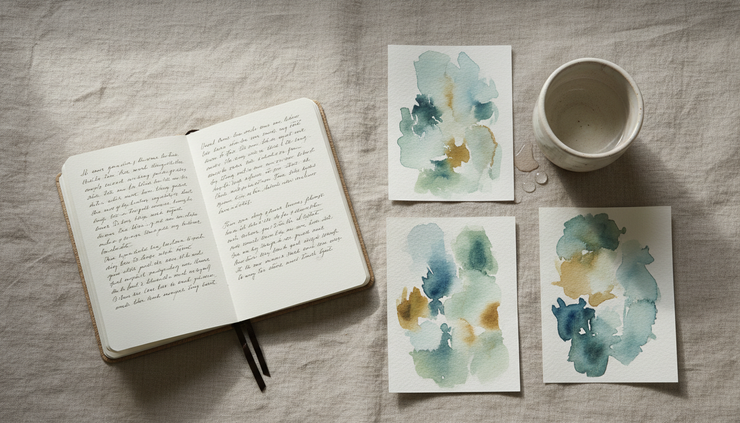
Let the painting remain partly unknown
The most meaningful encounters with abstract art often preserve a margin of uncertainty. A painting can be understood more deeply without being fully solved. In fact, its power may lie in that remaining openness.
To read an abstract painting well is to balance discipline and receptivity. Look closely at colour, line, movement, texture, impasto, glaze, negative space, scale, gesture, title, concept, and material. Then allow feeling to enter. Allow memory to stir. Allow the work to exceed the words used to describe it.
The goal is not to master the painting. The goal is to meet it with enough patience that it can act upon perception.
Abstract painting asks for a rare form of attention. It asks viewers to see without rushing to identify, to think without closing down feeling, and to feel without abandoning thought. Like instrumental music, it can move through tension, pause, density, silence, and release. It can hold what language struggles to name.
The next time an abstract painting seems difficult, stay with it a little longer. Begin with what is visible. Notice what changes. Listen with the eyes. Meaning may not arrive as an answer. It may arrive as a shift in perception, quiet at first, then unmistakable.


Comments