



Vincent van Gogh Painting Emotion Through Color and Light


Vincent van Gogh made paintings that seem to breathe, tremble and burn from within. Few artists have changed the way people understand colour, feeling and the visible world so profoundly.
Born in the Netherlands in 1853, Van Gogh became one of the defining figures of Post-Impressionism, although his fame arrived only after his death. In a career that lasted barely a decade, he transformed painting through his powerful use of colour, expressive brushwork and intense emotional vision. His canvases do not simply describe skies, rooms, flowers or fields. They carry states of mind.
Van Gogh’s life was marked by uncertainty, poverty, isolation and illness. Yet his determination to become an artist never weakened. He painted with urgency, often returning to the same subjects again and again, searching for a truer way to express what he saw and felt. Nature, light, rural labour, friendship, loneliness and spiritual longing all passed through his art and became something unforgettable.
His work sits at a turning point in modern art. It looks back to Dutch realism, Japanese prints, peasant life and Christian compassion. It also looks forward to Expressionism, abstraction and the modern idea that colour can communicate inner experience as powerfully as line or form.

Van Gogh’s early life shaped his sympathy for ordinary people
Vincent Willem van Gogh was born on 30 March 1853 in Groot-Zundert, a village in the southern Netherlands. He grew up in a Protestant family. His father was a pastor, and religious feeling remained part of Van Gogh’s imagination long after he moved away from formal church life. He did not begin as a painter. Like many young adults, he tried several paths before finding the one that would consume him.
As a teenager and young man, Van Gogh worked for the art dealers Goupil & Cie in The Hague, London and Paris. The job exposed him to prints and paintings, but it did not make him feel settled. He later worked as a teacher, a bookseller’s assistant and a lay preacher. His time among poor mining communities in the Borinage region of Belgium proved especially important. There he lived with people whose lives were shaped by hardship, manual labour and danger.
This experience gave Van Gogh a lasting sympathy for workers, peasants and the poor. His early drawings and paintings often show worn hands, bowed heads and dark interiors. He admired artists such as Jean-François Millet, whose images of rural labour carried monumental dignity. Van Gogh wanted art to honour people who rarely appeared in grand painting.
His decision to become an artist came relatively late. Around 1880, he committed himself to drawing and painting with extraordinary seriousness. He studied anatomy, perspective and figure drawing. He copied prints, visited museums and worked constantly. His early style was dark, earthy and grave. It reflected the northern European tradition, far removed from the blazing colour for which he later became famous.
The masterpiece of this early period is The Potato Eaters, painted in 1885. The figures sit around a table under dim lamplight, eating the food they have grown. Their faces are rough, their hands large and bony. Van Gogh did not idealise them. He wanted viewers to feel the weight of their lives and the honesty of their labour.
This concern for human experience never disappeared. Even when his palette brightened in France, Van Gogh kept searching for emotional truth in humble subjects: a chair, a pair of shoes, a café, a wheatfield, a bedroom, a vase of flowers. He did not need heroic themes. He found intensity in the ordinary.
His family did not always understand his choices, but his younger brother Theo became his closest supporter. Theo, an art dealer in Paris, sent money, offered advice and preserved Vincent’s letters. Those letters are among the most moving documents in art history. They reveal a restless, intelligent and deeply sensitive artist who thought constantly about colour, composition, nature, literature and the purpose of art.
Van Gogh’s financial dependence on Theo was painful to him. He sold very little during his lifetime and often lived in difficult conditions. Yet his self-discipline was immense. He worked through disappointment with a fierce belief that painting mattered. That perseverance helps explain the emotional force of the work. Each canvas seems to carry the pressure of someone trying to make life meaningful through art.
Colour and brushwork became his language of emotion
Van Gogh’s mature style emerged through study, travel and experiment. When he moved to Paris in 1886, he encountered Impressionism, Neo-Impressionism and Japanese woodblock prints. The effect was dramatic. His dark Dutch palette began to open. Browns and greys gave way to yellows, blues, greens, oranges and violets. He learned from the broken colour of the Impressionists, but he used it for different ends.
Impressionist painters often studied the shifting effects of light on modern life. Van Gogh absorbed their lessons, then pushed them towards emotional expression. For him, colour was never only optical. It could suggest tenderness, anxiety, heat, hope, reverence or sorrow. A yellow could feel like sunlight, friendship, faith or fever. A blue could hold calm, depth or spiritual distance.
His brushwork changed as well. He used strokes that are visibly active: short, directional marks, thick ridges of paint, swirling lines and pulsing contours. The surface of the painting became a record of physical movement. Looking at a Van Gogh painting, the viewer often senses the speed, pressure and rhythm of its making.
This is central to his art. He did not hide the painter’s hand. He made it unmistakable.
Van Gogh’s line also has emotional force. Trees twist, roads bend, rooms tilt, stars whirl and clouds move as if stirred by unseen currents. These distortions are not mistakes. They show how perception can be charged by feeling. The visible world becomes a partner in human emotion.
His time in Arles, in the south of France, marked a high point in this development. He arrived there in 1888, drawn by the clarity of southern light and the possibility of creating an artists’ community. He imagined Arles as a place of renewal. He painted orchards, cafes, drawbridges, fields, gardens, portraits and domestic interiors with astonishing speed.
The southern sun sharpened his sense of colour. He used complementary contrasts to create intensity: blue against orange, red against green, yellow against violet. These pairings gave his paintings a visual charge that still feels immediate. Colour became structure, mood and meaning at once.
His fascination with Japanese prints also shaped his approach. He admired their flat areas of colour, bold outlines, unusual cropping and attention to daily life. From them he learned that a picture did not need academic finish to be powerful. Simplicity, clarity and rhythm could carry deep feeling.
Van Gogh painted as if colour had a moral and emotional life. He wanted colour relationships to speak directly, beyond description. This desire helped open the way for later artists who would no longer treat colour as a servant of natural appearance, but as a force in its own right.
His masterpieces turn ordinary subjects into inner worlds
Van Gogh’s best-known works have become cultural icons, yet their familiarity should not soften their strangeness. They remain bold, searching and emotionally complex. Each major painting shows how he could transform a simple motif into an image of psychological and spiritual depth.
The Starry Night turns the sky into living motion
Painted in 1889 during Van Gogh’s stay at the asylum of Saint-Paul-de-Mausole in Saint-Rémy-de-Provence, The Starry Night is among the most recognisable paintings in the world. Its village lies beneath a vast night sky, where stars and moon flare like celestial lamps. A dark cypress rises in the foreground, linking earth and sky.
The painting is not a direct transcription of a single view. It combines observation, memory and imagination. The sky seems alive with spirals and waves. The village feels still, while the heavens move with immense energy. This contrast gives the work its emotional tension.
The cypress has often been associated with mourning and cemeteries, yet in the painting it also acts like a flame. It reaches upward, connecting human settlement to the cosmos. The result is not simply melancholy. It suggests awe, longing and a desire for connection beyond the self.
The colours deepen this effect. Blue dominates, but not as a flat darkness. It shifts through cobalt, ultramarine and greenish tones. Yellow stars puncture the night with warmth. Light appears as both comfort and mystery.
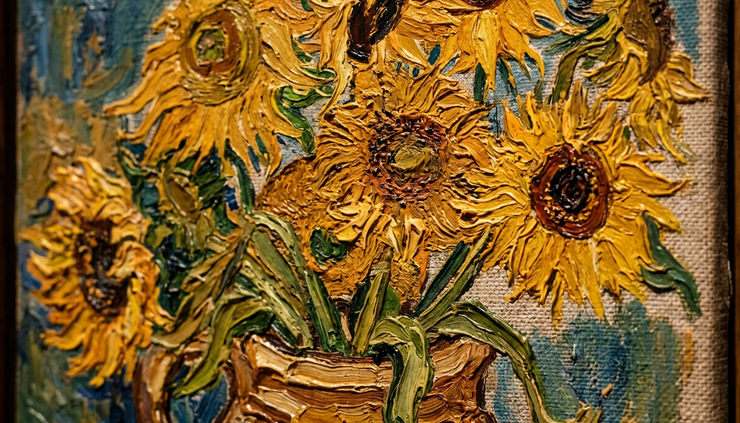
Sunflowers makes colour feel generous and mortal
Van Gogh painted several versions of Sunflowers, especially while preparing his Yellow House in Arles for the arrival of Paul Gauguin. These paintings were linked to hospitality, friendship and artistic hope. He wanted the sunflower pictures to decorate a shared creative home.
Their power lies partly in their apparent simplicity. A vase of flowers stands against a yellow ground. Yet within that narrow range, Van Gogh creates astonishing variation: lemon, gold, ochre, brown, green and orange. The flowers face different directions. Some bloom fully, some droop, some go to seed.
The series speaks of abundance, but also time. Flowers are never still. They open, blaze, fade and decay. Van Gogh turned this cycle into an image of life itself. The thick paint makes the petals almost sculptural, while the restricted palette tests how much feeling one colour family can hold.
The Bedroom presents rest as a fragile ideal
The Bedroom, painted in Arles in 1888 and later repeated, depicts Van Gogh’s room in the Yellow House. The subject is plain: bed, chairs, table, pictures on the wall, closed doors. Yet the room feels psychologically charged.
The perspective is uneven. The furniture seems to lean. The colours are clear and carefully chosen. Van Gogh intended the painting to express rest and simplicity. The strong outlines and flat planes show his interest in Japanese prints, while the empty room suggests both refuge and loneliness.
The painting’s emotional effect comes from this tension. It is an image of desired calm made by an artist who rarely found peace. The bed promises sleep. The paired chairs suggest companionship. The closed doors hint at separation. What looks simple becomes deeply human.
Irises finds vitality in the garden
Painted in 1889 at Saint-Rémy, Irises shows Van Gogh’s intense attention to natural forms. The flowers press across the surface with rhythmic movement. Their blue and violet petals stand against green leaves, with touches of earth and white adding contrast.
This painting is often read as less troubled than some other works from the same period. Its energy feels restorative. Van Gogh had long believed that nature could console and strengthen him. In Irises, the garden becomes a place of alertness and renewal.
The work also shows his gift for pattern. Each iris is distinct, yet the whole composition moves like a living field of forms. The image has decorative beauty, but it also conveys concentration. Van Gogh looked closely, and looking became a form of devotion.

Wheatfield with Crows intensifies the drama of nature
Wheatfield with Crows, painted in 1890 near the end of Van Gogh’s life, has often been surrounded by myth. It is sometimes described as his last painting, although that cannot be stated with certainty. What is clear is that it carries great emotional intensity.
A wide field of wheat spreads beneath a dark blue sky. Black crows fly across the scene. Paths cut into the field, but they do not lead to a clear destination. The brushwork is urgent. The colours clash with force: yellow wheat, dark sky, black birds, green paths.
The painting is not only an image of despair, though despair is often felt in it. It also shows the majesty and pressure of the natural world. The field seems alive, almost roaring. The crows may suggest death, but they also move with wild freedom. The picture holds fear, beauty and release in a single field of vision.
The self-portraits make identity visible
Van Gogh painted many self-portraits, in part because models were expensive. Practical need became artistic opportunity. Across these works, he studied his own face with unflinching attention. He appears bearded, gaunt, alert, wounded, composed, exhausted and determined.
The self-portraits are not exercises in vanity. They are investigations of identity. The background colours, brushwork and gaze shift from canvas to canvas. Sometimes his face seems carved from strokes of green, blue and ochre. Sometimes the eyes confront the viewer with unsettling directness.
After the crisis in Arles, when he injured his ear, Van Gogh painted himself bandaged. These images are painful, but they are also acts of survival. He shows himself not as a legend, but as a person continuing to make art after suffering.
Together, the self-portraits form one of the most moving sequences in modern painting. They reveal an artist who used his own image as a site of inquiry. Rather than presenting a fixed self, he shows identity as changing, vulnerable and alive.
Light, nature and rural life gave his art spiritual force
Van Gogh’s art cannot be separated from his feeling for nature. He painted orchards in blossom, wheatfields, olive trees, gardens, cypresses, farms, flowers, clouds, stars and roads. These subjects were not background. They were central to his understanding of existence.
He saw nature as active. Trees twist like bodies. Fields rise and fall like waves. Skies pulse with energy. Flowers seem to possess character. Even a patch of grass can feel animated by hidden life.
This connection grew from several sources. His religious upbringing gave him a habit of searching for meaning beyond surface appearances. His admiration for peasant life taught him to respect labour, seasons and the earth. His own emotional struggles made nature a source of consolation and intensity.
Rural life mattered to him because it felt close to fundamental experience: work, hunger, fatigue, growth, weather, harvest, rest and death. He did not paint peasants as picturesque figures. In his strongest works, they carry dignity. He gives weight to the gestures of sowing, digging, eating and walking home.
Light played an equally vital role. In the Netherlands, he explored the low glow of lamps and muted interiors. In Paris, he learned how light could fragment colour. In Arles, he met the full force of the southern sun. In Saint-Rémy and Auvers-sur-Oise, light often became more turbulent, less stable, more inward.
Van Gogh’s famous yellows have many meanings. They can suggest sunlight, wheat, flowers, warmth and friendship. Yet they can also feel feverish or fragile. His blues can cool a composition or open it towards the infinite. His greens may bring renewal or tension. The emotional meaning emerges through relationship, not isolated colour.
This is why his palettes feel so alive. He understood colour as interaction. A yellow changes when placed beside violet. A red intensifies near green. A blue becomes deeper beside orange. These contrasts were not technical tricks. They allowed him to build emotional temperature.
His paintings also show sympathy for human spaces. A café at night becomes a place of loneliness and moral unease. A bedroom becomes a hoped-for refuge. A chair becomes a portrait without a face. A pair of shoes bears the memory of walking and work. In Van Gogh’s hands, objects seem to retain human presence.
This ability to transform ordinary subjects into extraordinary works of art lies at the heart of his greatness. He did not need luxury, myth or grand spectacle. He made the simplest things carry feeling. He taught later generations that a painting of flowers, a field or a room could reveal an entire inner life.

His influence made modern art more emotionally fearless
Van Gogh died on 29 July 1890 in Auvers-sur-Oise, aged 37. During his lifetime, he received little public recognition. After his death, his reputation grew through exhibitions, collectors, critics and the dedication of those who preserved and promoted his work, especially Theo’s widow, Jo van Gogh-Bonger.
His influence on modern art is vast. He helped free colour from strict naturalism. He showed that brushwork could carry feeling rather than simply describe form. He proved that distortion could reveal truth when used with conviction. These ideas became central to Expressionism and to much of twentieth-century art.
Expressionist artists found in Van Gogh a model of emotional directness. His paintings showed that art could convey inner states through colour, line and rhythm. German and Austrian Expressionists, among others, took this lesson further, often making colour even more intense and form more angular. Van Gogh’s example helped legitimise art as a record of psychological and spiritual experience.
Fauvism also owes something to his bold colour. Artists such as Henri Matisse and André Derain pushed colour into new freedom, using strong contrasts and non-natural palettes. While their aims differed from Van Gogh’s, his work helped prepare the way for colour as an independent expressive power.
Later artists admired his authenticity, but that word must be used carefully. Van Gogh’s art was not raw confession alone. It was highly considered. He read widely, studied other artists, planned colour schemes and thought deeply about composition. The emotional force of his work comes from discipline as much as feeling.
His enduring popularity has many causes. The paintings are immediately recognisable. Their colours and textures communicate before any explanation begins. They are also tied to a life story that many people find moving: struggle, poverty, devotion, illness, hope and posthumous recognition.
Yet the public fascination with his suffering can sometimes flatten the art. Van Gogh should not be reduced to the myth of the suffering genius. His illness was real and serious, but his paintings are not valuable because he suffered. They matter because he transformed experience into form with extraordinary intelligence and courage.
The paintings continue to resonate because they hold opposing feelings together. The Starry Night is anxious and wondrous. Sunflowers is joyful and mortal. The Bedroom is calm and lonely. Wheatfield with Crows is threatening and beautiful. The self-portraits show vulnerability and resolve. This emotional complexity makes the work feel close to life.
Van Gogh also speaks to modern viewers because he honoured attention. In an age of distraction, his paintings ask for sustained looking. A single chair, iris or field becomes worthy of care. His art suggests that the world is never merely ordinary if seen with enough intensity.
His letters deepen this connection. They show an artist who struggled, failed, learned and kept going. They reveal his desire to create art that could console people, not by denying hardship, but by giving it shape. For many, this makes him a figure of resilience as well as artistic brilliance.
The global popularity of Van Gogh exhibitions, museum collections and reproductions proves that his art crosses language and culture. People respond to the directness of his colour and the humanity of his subjects. The paintings feel personal without becoming private. They invite viewers into a heightened version of the world they already know.
Vincent van Gogh remains one of the most celebrated artists in history because he expanded what painting could express. He gave colour emotional authority. He made light feel spiritual. He turned brushstrokes into living marks. He transformed bedrooms, flowers, fields and faces into images of human longing.
His vision continues to inspire artists and viewers because it joins fragility with creative force. Van Gogh did not find an easy life, but he found a way to make life visible in paint. That achievement still feels urgent. His art reminds us that seeing can be an act of feeling, and that beauty can emerge from persistence, attention and the courage to paint the world as intensely as it is lived.


Comments