



Andrea del Verrocchio Mentor of Leonardo and Master of Florence

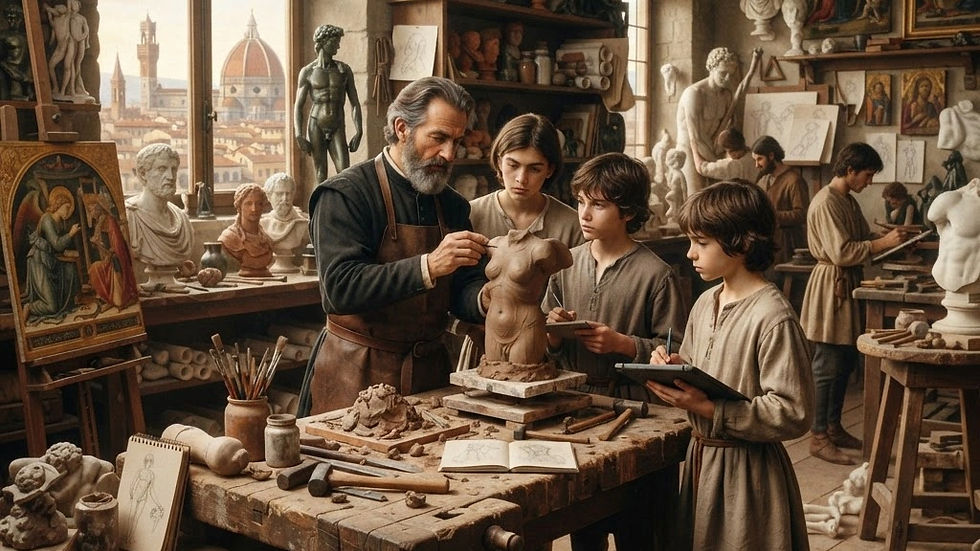
Andrea del Verrocchio stands at the centre of Renaissance Florence, yet he often appears in art history as a supporting figure in the story of Leonardo da Vinci. That view is too narrow. Verrocchio was not only Leonardo’s teacher. He was a sculptor of unusual force, a painter of refined intelligence, a goldsmith trained in precision, and a designer whose workshop helped shape the visual culture of late 15th-century Italy.
Born Andrea di Michele di Francesco de’ Cioni in Florence around 1435, he came of age in a city where art, science, commerce and civic ambition met with extraordinary intensity. He became known as “Verrocchio”, probably from the name of a goldsmith with whom he was associated. By the height of his career, his workshop had become one of the most important centres of artistic learning in Europe. It was a place where young artists studied drawing, anatomy, metalwork, devotional painting, sculpture, mechanics and design as parts of a single discipline.
Verrocchio’s legacy survives in bronze and marble, in painted panels, in fragile attributions, and in the achievements of pupils who carried his lessons into the High Renaissance. To understand Leonardo, Perugino, Lorenzo di Credi and many others, one must first understand the master who trained them to look harder, work more carefully and think with their hands.

Verrocchio’s early life was shaped by craft, discipline and Florence
Florence in Verrocchio’s youth was a city of artistic competition. Brunelleschi had transformed architectural thinking. Donatello had expanded the expressive possibilities of sculpture. Masaccio had changed the language of painting through perspective and volume. The Medici family, bankers and patrons, helped create a culture in which art served devotion, status, civic identity and intellectual enquiry.
Verrocchio emerged within this demanding environment. His family background was modest rather than aristocratic, and his early formation appears to have been practical. Like many Renaissance artists, he likely began through craft training rather than through the modern idea of fine-art education. The goldsmith’s shop was one of the most exacting schools available in Florence.
Goldsmiths worked at small scale with rare materials. They learned to cut, cast, chase, polish and join. They handled line, relief and ornament with exactness. They understood how light moved across metal. They also produced objects that combined design with engineering, from reliquaries and jewellery to ceremonial fittings. This training gave Verrocchio a lifelong sensitivity to surface, edges and technical finish.
His artistic development cannot be reduced to a single teacher. Scholars have connected his formation with goldsmiths, painters and sculptors active in Florence, including artists in the orbit of Donatello’s influence. What matters most is the kind of education he absorbed. Verrocchio learned in a city where the best artists did not separate intellectual ambition from manual skill. A sculptor could also be an engineer. A painter could study anatomy. A goldsmith could design monuments.
That breadth became his signature.
By the 1460s and 1470s, Verrocchio had risen to prominence. He received important commissions from religious institutions, civic bodies and elite patrons. His patrons included the Medici, whose taste for refined and learned art suited his abilities. He produced tombs, devotional images, portrait sculpture, bronze figures and large public works. His studio gained a reputation not only for quality but also for range.
This range was not accidental. It reflected the Renaissance ideal of the artist as a maker who could solve many kinds of visual and technical problems. Verrocchio’s art was grounded in close observation, but it was also rooted in workshop discipline. Drawing, modelling, casting and finishing were not separate activities. They formed a continuous path from idea to object.
His versatility reveals the Renaissance artist as a complete maker
Verrocchio is often described as a sculptor, and sculpture does stand at the heart of his achievement. Yet he worked across several media with skill. He was a painter, goldsmith, bronze founder, designer and organiser of complex workshop production. This versatility made him one of the defining artistic figures of late Quattrocento Florence.
The Renaissance workshop functioned less like a private studio and more like a collaborative laboratory. It produced altarpieces, small devotional panels, festival objects, sculpture, architectural decoration and designs for patrons. Junior artists learned by copying, preparing materials, assisting on commissions and gradually taking responsibility for parts of larger works.
Verrocchio’s command of many materials made his workshop especially fertile. The habits of the goldsmith are visible even in his large sculptures. Drapery is carefully structured. Hair is treated with rhythmic precision. Hands and faces show an alertness to living form. Bronze surfaces catch light in lively ways, while marble works carry a sense of refined finish.
Several qualities recur across his output:
Technical exactness Verrocchio’s figures show careful planning and fine finishing. His surfaces rarely feel casual.
Interest in movement He often presents figures as if caught between actions, turning, stepping, pausing or responding.
Attention to anatomy His bodies have structure beneath the surface. Even youthful figures suggest bones, muscles and balance.
Psychological alertness His best works do not simply occupy space. They seem aware of it.
Integration of craft and intellect He treated making as a form of thinking, not as mechanical execution.
These qualities gave his work a distinctive position between early Renaissance clarity and the more complex naturalism of the High Renaissance. He inherited the lessons of Donatello and his generation, but he pressed them towards sharper observation and greater physical immediacy.
Verrocchio’s art teaches a central Renaissance lesson: beauty was not separate from method. It grew from disciplined looking, skilled hands and an exact knowledge of materials.
His major sculptures brought realism and motion into public form
Verrocchio’s reputation rests above all on sculpture. His major works show a master able to combine grace with tension, finish with vitality, and classical balance with vivid human presence.
David gives youth a new kind of energy
Verrocchio’s bronze David, now in the Bargello in Florence, offers a brilliant contrast to Donatello’s earlier and more enigmatic David. Verrocchio’s figure is clothed, alert and poised. The young hero stands with one hand on his hip and the sword angled beside him. The severed head of Goliath rests at his feet, but the sculpture avoids heavy drama.
What makes the work so compelling is its precise balance between confidence and youth. This David is not a monumental warrior. He is slender, almost elegant, but not fragile. His body turns slightly. His expression carries intelligence and self-possession. The figure seems to occupy a social world as much as a biblical one. He might be read as a biblical hero, a civic emblem, or an idealised Florentine youth.
The bronze surface shows Verrocchio’s goldsmith-like refinement. Details of clothing, hair and anatomy are handled with care. The body does not stand as a static column. It shifts and breathes. Verrocchio understood that naturalism depends not only on correct proportion but also on the suggestion of life in transition.
The sculpture may also reveal the atmosphere of the Medici circle, where biblical, classical and civic meanings often overlapped. David symbolised Florence’s self-image as a small power capable of confronting larger enemies. Verrocchio gave that symbol polish, intelligence and youthful force.

Christ and St Thomas transforms a niche into theatre
Verrocchio’s bronze group Christ and St Thomas, made for Orsanmichele in Florence, is one of his great public achievements. The work occupies a niche, yet it refuses to behave like a flat decorative object. Christ stands with solemn authority, while Thomas reaches towards the wound in Christ’s side. The subject demanded both theological seriousness and physical interaction.
Verrocchio solved the problem with remarkable intelligence. The two figures relate to one another through gesture, gaze and spatial tension. Thomas leans in, hesitant yet compelled. Christ opens his garment with calm assurance. The drapery falls in complex folds that give the figures weight and rhythm.
The niche becomes a stage. The viewer stands outside the sacred encounter but is drawn into it through the gestures. This is not merely illustration. It is a sculptural drama about doubt, touch and revelation.
The technical difficulty was also significant. Bronze casting at this scale required planning, resources and workshop skill. Verrocchio’s experience with metal allowed him to manage the relationship between structural demands and expressive aims. He did not sacrifice movement to stability.
Putto with Dolphin shows playfulness and engineering
The Putto with Dolphin, associated with Medici patronage and now in Florence, reveals another side of Verrocchio. A child figure twists while holding a dolphin, originally connected with water and fountain design. The sculpture is playful, but its balance is sophisticated. The turning body, raised limbs and implied flow of water create a sense of circular movement.
This work shows Verrocchio’s ability to join sculpture with environment. Renaissance artists often designed objects for specific architectural or garden settings. A fountain sculpture had to work visually, technically and spatially. It needed to carry water, catch light and reward movement around it.
The child’s body is studied with affection and anatomical interest. The softness of flesh, the twist of the torso and the alert physicality all suggest close observation. Verrocchio does not treat childhood as a generic idea. He studies it as a living form.
The Equestrian Monument of Bartolomeo Colleoni crowns his career
Verrocchio’s Equestrian Monument of Bartolomeo Colleoni in Venice is his most ambitious public sculpture. Colleoni was a military commander who left funds for a monument in the Venetian Republic. Verrocchio won the commission and developed the model, but he died in Venice in 1488 before the bronze was cast. The casting was completed after his death, with Alessandro Leopardi playing a major role in the final execution and base.
The monument remains one of the great equestrian statues of the Renaissance. It stands in dialogue with Donatello’s Gattamelata in Padua, yet Verrocchio’s answer is more aggressive, more dynamic and more sharply psychological. Colleoni does not merely sit on a horse. He commands through posture, expression and forward force.
The horse strides with muscular energy. The rider’s torso turns with authority. The face is stern, almost fierce. Every part contributes to the impression of disciplined power. Verrocchio transformed the equestrian monument into an image of will.
The technical challenge was immense. Large bronze equestrian monuments required mastery of modelling, casting, balance and assembly. They also carried political meaning. Venice, a republic wary of individual military glory, placed the monument outside the central spaces Colleoni had requested. Even so, Verrocchio’s sculpture projects public authority with unforgettable force.
In the Colleoni monument, Verrocchio’s concern with movement, anatomy and metalwork reached its highest public form. The result looks back to antiquity and forward to later heroic monuments, yet it keeps the intense realism of the Florentine workshop.
His paintings show a workshop culture of collaboration and experiment
Verrocchio’s reputation as a painter is more complex than his reputation as a sculptor. Fewer paintings can be securely assigned to his hand, and several works associated with his workshop involved collaboration. This uncertainty is not a weakness in the story. It reveals how Renaissance workshops actually functioned.
A master supplied designs, supervised production and sometimes painted key passages. Assistants prepared panels, transferred drawings, painted secondary areas or completed versions for different patrons. Authorship could be collective, especially in a busy and successful workshop.
The most famous painting linked to Verrocchio is The Baptism of Christ, now in the Uffizi. The work is traditionally associated with Verrocchio and his workshop, with Leonardo da Vinci credited with painting one of the angels and possibly parts of the landscape. The contrast between passages has long fascinated viewers. Leonardo’s angel, with its soft modelling and subtle atmosphere, seems to point towards a new pictorial language.
Yet seeing the painting only as the moment Leonardo surpassed his teacher misses the deeper lesson. Leonardo developed within Verrocchio’s visual culture. The workshop had already trained him to value observation, technical experiment and the study of light on form. Verrocchio created the conditions in which such innovation could occur.
Other paintings associated with the Verrocchio circle, including versions of the Madonna and Child and works such as Tobias and the Angel, show the workshop’s interest in elegant figures, crisp drawing, decorative detail and natural observation. In these works, one often senses the crossing of media. Drapery can feel sculptural. Hands are carefully articulated. Jewellery and textile details reveal the eye of a goldsmith.
Painting in Verrocchio’s workshop was not isolated from sculpture. A figure drawn for a panel could be understood as a body in space. A painted head could reflect the study of portrait busts. A landscape passage could emerge from habits of direct observation. This cross-fertilisation helped prepare the art of the next generation.

The workshop made Verrocchio one of the great teachers of the Renaissance
Verrocchio’s workshop was among the most influential art schools of Renaissance Florence, even though it was not a school in the modern sense. It was a place of labour, training and ambition. Young artists entered as apprentices and learned through repetition, correction and participation in real commissions.
The workshop’s strength lay in its breadth. Students encountered drawing, painting, sculpture, metalwork and design. They learned to prepare surfaces, grind pigments, model clay, study drapery, draw from objects and assist with complex projects. They saw how a commission moved from patron request to drawing, model, material execution and final installation.
This practical education shaped artists who would later become central to Renaissance art.
Leonardo da Vinci is the most famous pupil. Born in Vinci in 1452, he entered Verrocchio’s workshop as a young man and absorbed its culture of disciplined observation. Leonardo’s later notebooks, with their anatomical sketches, mechanical studies, water diagrams and optical investigations, are often treated as signs of isolated genius. They were genius, but they also grew from a Florentine workshop world that joined art to technical enquiry.
Verrocchio gave Leonardo a model of the artist as investigator. The lesson was not simply how to paint a hand or cast a figure. It was how to look at the world as a structure of forces, surfaces, bodies and movements.
Other artists connected with Verrocchio’s workshop or circle included Lorenzo di Credi, who inherited and preserved aspects of the master’s style, and Pietro Perugino, whose calm compositions and graceful figures would influence Raphael. Artists such as Domenico Ghirlandaio and Sandro Botticelli have also been discussed in relation to Verrocchio’s broader Florentine environment, though the exact nature of every connection varies in the evidence.
What is clear is that Verrocchio’s workshop stood at a crossroads. It gathered young talent at a moment when Florentine art was moving from the measured clarity of the early 15th century towards the richer naturalism of the High Renaissance. The workshop taught not only style but method.
That method involved:
sustained drawing from models and objects
careful study of hands, heads and drapery
attention to proportion and balance
respect for materials and tools
collaboration under a master’s direction
movement between two-dimensional and three-dimensional thinking
visual problem-solving across sacred, civic and private commissions
Verrocchio’s achievement as a teacher rests in this combination. He did not produce imitators alone. He trained artists capable of extending his principles beyond him.
His relationship with Leonardo was apprenticeship, not legend
The story of Verrocchio and Leonardo has often been reduced to a famous anecdote: Leonardo painted an angel so beautifully in The Baptism of Christ that Verrocchio gave up painting. The tale is memorable, but it should be treated with caution. It reflects later admiration for Leonardo more than secure documentation about Verrocchio’s decisions.
The real relationship was more interesting.
Leonardo entered a workshop that demanded discipline. He learned from a master who prized exact drawing, technical skill and observation of nature. Verrocchio’s studio would have exposed him to sculpture, metalwork, mechanics, costume, religious imagery and the demands of patrons. Leonardo’s later ability to think across art and science did not arise in a vacuum.
Verrocchio’s influence can be seen in Leonardo’s early concern with:
the structure of the human body
the expressive power of gesture
the behaviour of light on curved surfaces
the importance of preparatory drawing
the union of design and technical execution
the study of motion in people, animals and water
Leonardo moved beyond Verrocchio in atmosphere, psychological complexity and scientific range. Yet even those advances retain the imprint of workshop training. Verrocchio taught him that art required intellectual seriousness and manual mastery. This lesson remained central to Leonardo’s career.
The title Andrea del Verrocchio Mentor of Leonardo and Master of Florence captures only part of the relationship. Verrocchio was a mentor to Leonardo, but he was also a master in his own right. Leonardo’s brilliance should not obscure the environment that formed him. If anything, it reveals the strength of that environment.
A great teacher does not disappear behind a great student. The student’s achievement can illuminate the teacher’s depth.
Craftsmanship and anatomy gave his art its authority
Verrocchio’s art depends on a close relationship between craftsmanship, observation and anatomical understanding. He did not treat anatomy as dry information. He used it to make bodies credible, expressive and active.
In sculpture, this concern becomes physical. A figure must stand, turn, lean or gesture convincingly. Weight must pass through hips, knees and feet. Drapery must respond to the body beneath it. A hand must press, grip or open in a way that feels true. Verrocchio’s works often succeed because these details cohere.
His goldsmith training sharpened this realism. Metalwork teaches patience. It punishes vagueness. Edges, joins and surfaces must be controlled. Such habits informed Verrocchio’s sculpture, where finish and structure operate together. The viewer senses a mind that understands both the body and the material.
His attention to proportion also reflects a wider Renaissance concern. Artists in Florence studied ancient sculpture, human measurement and mathematical order. Yet Verrocchio avoided cold formula. His figures have liveliness because proportion serves action. In David, the slight turn of the body matters as much as the idealised youth. In Christ and St Thomas, gesture gives theology a human form. In Colleoni, anatomy and posture become public authority.
Observation was central. Renaissance artists increasingly looked at the visible world not as a storehouse of symbols alone but as a field of study. Muscles, fabric, hair, animals, plants, water and light all became subjects of attention. Verrocchio’s workshop helped normalise this discipline of looking.
This is one reason his place in art history is so important. He helped bridge early Renaissance traditions and later innovations. The early Renaissance had established perspective, volume and classical aspiration. Verrocchio’s generation intensified the study of natural movement, technical finish and the expressive body. Leonardo and others would carry those concerns much further, but Verrocchio helped provide the foundation.
Florence gave Verrocchio patrons, pressure and purpose
Verrocchio’s career cannot be separated from Florence. The city’s artistic culture depended on competition among workshops, the ambitions of families and guilds, and the prestige of public commissions. Artists had to satisfy patrons while also distinguishing themselves within a crowded field.
The Medici played a major role in this environment. Their patronage shaped taste across painting, sculpture, architecture and collecting. Verrocchio’s refined surfaces, elegant figures and technical sophistication suited Medici culture. Works such as the David, the Putto with Dolphin and the tomb of Piero and Giovanni de’ Medici reflect an art of intelligence, status and controlled beauty.
The tomb of Piero and Giovanni de’ Medici in San Lorenzo is especially revealing. Rather than relying on a conventional figural programme, Verrocchio created a work of rich materials and ornamental intelligence. Bronze, porphyry and marble combine in a design that is both architectural and decorative. The tomb demonstrates his ability to think as a designer of objects, spaces and surfaces.
Florence also gave Verrocchio a demanding public. Works for churches, guild settings and civic spaces had to speak clearly while rewarding close attention. The artist needed to balance devotion, status, theology and visual splendour. Verrocchio’s ability to manage these competing demands made him valuable.
His influence on sculpture was direct and lasting. He developed a language of poised movement, refined naturalism and technical brilliance. His bronze figures helped push Florentine sculpture beyond static elegance towards more active forms of presence.
His influence on painting was partly mediated through pupils. The workshop’s drawing practices, interest in sculptural form and respect for observed detail helped shape artists who would dominate central Italian painting. Through Leonardo, Perugino and others, Verrocchio’s teaching reached far beyond his own signed works.
His influence on artistic education may be his greatest legacy. The workshop model existed before him, of course, but Verrocchio made his shop a particularly powerful engine of talent. It trained artists to think across materials. It encouraged exactness. It joined handwork to inquiry.

Verrocchio remains overlooked because his influence is everywhere
Verrocchio’s relative obscurity has several causes. He left fewer universally known works than Leonardo, Michelangelo or Raphael. Some paintings connected with his workshop are difficult to attribute. Several of his achievements were collaborative or completed by others. His identity as a teacher has also encouraged later audiences to see him mainly as a prelude to Leonardo.
Yet this underestimates the nature of Renaissance creativity. Workshops, collaborations and artistic lineages were not secondary to genius. They were the conditions that made genius possible. Verrocchio stands precisely at that point where craft, teaching, patronage and experiment meet.
His own works deserve close attention. David offers one of the most refined images of youthful victory in Renaissance bronze. Christ and St Thomas turns a niche into a profound encounter between faith and touch. The Putto with Dolphin joins play, anatomy and fountain design. The Colleoni monument gives military command a form of concentrated energy. His funerary and decorative works reveal a designer of rare intelligence.
His paintings and workshop productions show a culture of experiment. They remind us that artistic advances often emerge from shared practice rather than solitary inspiration. Leonardo’s angel in The Baptism of Christ matters not because it cancels Verrocchio, but because it shows the workshop at its most fertile.
Verrocchio also matters because he clarifies what Renaissance art was. It was not only a series of masterpieces. It was a system of training, making and looking. It demanded the eye of a naturalist, the patience of a craftsperson, the imagination of a poet and the discipline of an engineer. Few artists embodied that system more completely.
His legacy survives through two intertwined paths. The first is material: bronze, marble, painted panels and designs that still carry the pressure of his hand and intellect. The second is educational: the artists he trained, the methods he transmitted and the culture of observation he strengthened.
To place Verrocchio back at the centre of Renaissance Florence is not to diminish Leonardo. It is to see Leonardo’s world more clearly. Verrocchio was one of the artists who made that world possible. He taught a generation to trust the eye, respect materials and give thought a visible form. That is why Andrea del Verrocchio remains one of the most significant, and still too often overlooked, masters of the Renaissance.


Comments