


Global Centers of Modern and Contemporary Art: 6 Museums Defining Visual Culture

Museums don’t just store art. The strongest ones change how art is seen, collected, written about, and remembered.
That’s why the world’s leading modern and contemporary art museums matter far beyond their walls. They shape taste. They frame movements. They turn buildings into cultural arguments. They give artists space to test how painting, installation, film, photography, performance, and architecture can hold time, memory, and public life.
This guide focuses on six institutions that changed the terms of visual culture.
They are not ranked. Each one carries a different kind of influence: curatorial, architectural, urban, regional, and historical.
Terms like “top art institutions worldwide”, “contemporary art galleries global”, “MoMA Tate Modern Pompidou”, “architectural icons in art”, and “global visual culture hubs” may sound blunt, but they point to a serious question: which museums have shaped how the world looks at modern and contemporary art?
The six institutions at a glance
Institution | City | Core identity | Why it matters |
Museum of Modern Art | New York | Pioneer of modernism | Helped define the modern art canon through collection, exhibitions, and scholarship |
Tate Modern | London | Industrial space turned contemporary powerhouse | Changed expectations for scale, public access, and the museum experience |
Centre Pompidou | Paris | High-tech cultural machine | Placed the European avant-garde inside a radical public building |
Guggenheim Museum Bilbao | Bilbao | Architectural sculpture | Proved a museum could reshape a city’s global identity |
National Art Center, Tokyo | Tokyo | Non-collecting exhibition platform | Built a major model for temporary, large-scale contemporary exhibitions |
Zeitz MOCAA | Cape Town | Pan-African contemporary art platform | Created a major museum stage for artists from Africa and its diaspora |
1. MoMA in New York defined the grammar of modern art

The Museum of Modern Art opened in New York in 1929. That date matters. The museum arrived at a point when modern art still needed public argument, not only display. European modernism, new photography, design, architecture, and film did not yet sit comfortably inside traditional museum structures.
MoMA helped change that.
Its first director, Alfred H. Barr Jr., treated modern art as a broad field. Painting and sculpture mattered, but so did photography, architecture, design, film, prints, and books. That approach feels normal now. It wasn’t normal then. It gave modern visual culture a structure that collectors, scholars, museums, and the public could use.
MoMA’s collection became one of the most influential in the world. Works by artists such as Pablo Picasso, Vincent van Gogh, Henri Matisse, Piet Mondrian, Jackson Pollock, Frida Kahlo, Andy Warhol, and Cindy Sherman helped form a public idea of what modern and contemporary art could be. The museum didn’t only show individual works. It built relationships between movements: Cubism, Constructivism, Surrealism, Abstract Expressionism, Pop Art, Minimalism, Conceptual Art, and beyond.
The museum’s power lies in its clarity. MoMA made modernism legible without making it simple. It turned difficult shifts in art history into rooms, sequences, catalogues, and educational programmes that shaped generations.
That influence also brought pressure. A canon can clarify, but it can also exclude. In recent decades, MoMA has worked to broaden its story. The museum has placed more attention on women artists, artists from outside Europe and the United States, and practices once treated as peripheral.
For collectors and curators, MoMA remains a reference point. Its acquisitions and exhibitions can reshape scholarship. Its galleries show how an institution can connect formal experiment with social change.
Representative photograph placement
Use an exterior photograph of MoMA’s Manhattan façade or an interior view showing its clean gallery architecture and flowing public spaces.
Image prompt description
An architectural photograph of MoMA should feel precise and restrained. Focus on glass, stone, urban scale, and the idea of modernism as order, light, and movement.
2. Tate Modern turned industrial architecture into a contemporary art stage
Tate Modern opened in 2000 inside the former Bankside Power Station on the south bank of the River Thames. The building was designed as a power station by Giles Gilbert Scott and later transformed into a museum by Herzog & de Meuron.
That conversion changed museum thinking.
Tate Modern didn’t hide the industrial past of the site. It used it. The Turbine Hall became one of the most recognisable interior spaces in contemporary art. It gave artists room to work at a scale rarely possible in conventional galleries. Large installations, sound works, participatory projects, and spatial experiments could happen without feeling forced.
The museum also changed London’s cultural geography. The south bank became a major destination for contemporary art, not an edge condition outside the older centres of power. The building linked art, public space, walking, architecture, and the city’s riverfront.
Tate Modern matters because it treats contemporary art as a public event. You don’t need to enter through ceremony. You enter through space. The building invites movement before explanation. That physical openness made contemporary art feel less sealed off.
The collection draws from the wider Tate holdings and includes major work across the 20th and 21st centuries. Its displays often avoid simple chronology. Instead, they group works through themes, materials, ideas, and global connections. That matters because contemporary art does not move in a straight line. It loops across politics, memory, identity, abstraction, technology, and the body.
Tate Modern also helped make the museum visit more fluid. The Turbine Hall can act like a public square. The galleries can feel more intimate. The building holds both mass experience and close looking.
For artists, the institution offers scale. For curators, it offers a model of spatial thinking. For collectors, it shows how contemporary work gains meaning when architecture does more than provide walls.
Representative photograph placement
Place a wide interior photograph of the Turbine Hall here, ideally from an upper level looking down into the main axis of the former power station.
Image prompt description
A strong Tate Modern photograph should show the vast industrial interior, the long Turbine Hall floor, the overhead structure, and the sense of contemporary art occupying a former site of energy production.
3. Centre Pompidou made the museum visible as a machine for culture
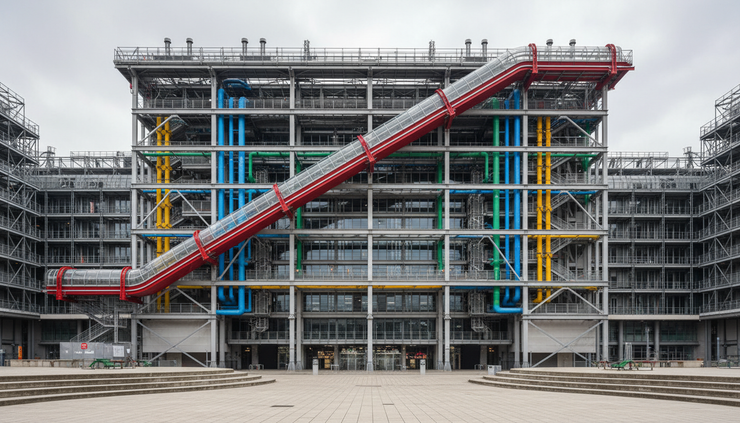
Centre Pompidou opened in Paris in 1977. Designed by Renzo Piano and Richard Rogers, with Gianfranco Franchini, it looked unlike the traditional museum. Its services, tubes, escalators, and structural systems were pushed outward. The building made its working parts visible.
That move was more than a design statement. It changed the cultural tone. The museum no longer posed as a silent temple. It became a public machine for art, reading, gathering, and movement.
The Centre Pompidou houses the Musée National d’Art Moderne, one of Europe’s major collections of modern and contemporary art. Its holdings cover key 20th-century movements, including Fauvism, Cubism, Dada, Surrealism, abstraction, post-war European art, design, photography, film, and contemporary practice.
The building’s radical appearance also matched its institutional ambition. It brought a museum, public library, performance spaces, and research activity into one cultural complex. That mix made it an active civic place, not only a sequence of galleries.
Pompidou’s strength lies in its connection between the avant-garde and the public. It gave experimental culture a central address in Paris. That mattered in a city already filled with deep art history. The institution didn’t compete with the Louvre’s image of the past. It claimed the present as a public right.
The museum also helped change how people think about transparency. Its visible escalators and structure suggest circulation, access, and use. The building tells visitors that culture is made, moved through, revised, and shared.
For contemporary curators, Pompidou remains a sharp lesson. Architecture can carry intellectual force. A building can teach visitors how to move, watch, and question authority before they even reach the art.
For collectors, the collection provides a European frame that is broad without being vague. It connects canonical modernism to later forms of conceptual and interdisciplinary work.
Representative photograph placement
Use an exterior photograph of the building facing the public plaza, with the coloured structural systems and escalator tubes clearly visible.
Image prompt description
A Pompidou image should show the building as an exposed cultural engine, with pipes, steel, glass, and public space working together.
4. Guggenheim Museum Bilbao turned architecture into urban identity

The Guggenheim Museum Bilbao opened in 1997 and quickly became one of the most discussed museum buildings in the world. Designed by Frank Gehry, its titanium curves changed the image of Bilbao and altered how cities thought about cultural infrastructure.
The museum is often discussed through the “Bilbao effect”, a phrase used to describe the way a major cultural building can help reshape a city’s global profile. The phrase can be overused, but the case is real. Bilbao’s museum became a symbol of urban renewal, tourism, and architectural ambition.
The building works like sculpture. It resists the box. Its surfaces catch light, weather, river reflections, and movement from different angles. The exterior never offers a single settled image. That shifting quality matters. It turns the act of viewing into a spatial event.
Inside, the museum has large galleries suited to monumental works, installations, and modern and contemporary exhibitions. Richard Serra’s large steel works, strongly associated with the museum, show how sculpture can control time and bodily movement. Visitors don’t simply look at form. They walk through it. Their sense of scale, distance, and direction changes.
That is where the museum’s deeper importance sits. Guggenheim Bilbao fused object, site, city, and public imagination. It made the museum itself part of the artwork.
The risk with such architecture is clear. A powerful building can overshadow the art inside. Bilbao avoids that risk when its exhibitions engage scale, material, and movement with equal force. The best shows there understand the building as a partner, not a backdrop.
For collectors and curators, Guggenheim Bilbao remains essential because it raised the stakes of space. It showed that contemporary art institutions must think beyond walls and labels. They shape how an entire city is perceived.
Representative photograph placement
Use an exterior photograph from the river edge showing the titanium skin, curved volumes, and relationship between the museum and Bilbao’s urban fabric.
Image prompt description
A strong Bilbao image should emphasise sculptural architecture, reflective metal, water, and the museum’s role as a civic landmark.
5. The National Art Center, Tokyo built power through temporary exhibitions
The National Art Center, Tokyo opened in 2007 in Roppongi. Designed by Kisho Kurokawa, the building is known for its wave-like glass façade and large interior spaces. Its most important institutional feature is simple: it does not maintain a permanent collection.
That choice makes it different.
Many major museums build authority through ownership. The National Art Center builds authority through programming. It functions as a vast exhibition platform, hosting large temporary shows, artist association exhibitions, major domestic presentations, and international projects.
This non-collecting model changes the centre of gravity. The institution doesn’t ask visitors to return to the same masterpieces. It asks them to return to changing questions. What is being shown now? Which artists need room? Which histories need a temporary but serious public form?
Tokyo is one of the world’s great visual cities, with deep connections to design, photography, fashion, architecture, manga, cinema, craft, and contemporary art. The National Art Center fits that wider field by acting as a large public stage. It can host exhibitions at a scale smaller museums cannot manage.
The building itself supports that role. Its glass façade creates a strong relationship between interior and exterior. The public spaces feel open, curved, and fluid. This matters in a city where density shapes everyday life. The museum creates a pause without cutting itself off from urban energy.
The centre is also important for thinking about time. A collecting museum often works through permanence. A non-collecting museum works through sequence. It produces cultural memory through moments, catalogues, public attendance, and repeated exhibition cycles.
For contemporary painting, installation, and multimedia work, this model has real force. It lets exhibitions breathe at scale. It allows curators to form large arguments without being bound to a house collection. It also gives living artists access to rooms that can hold ambition.
Representative photograph placement
Place an exterior photograph of the wave-like glass façade here, ideally showing the curve of the building and the transparency of the public interior.
Image prompt description
A strong National Art Center image should focus on the curved glass façade, the smooth public architecture, and the idea of a museum built for large temporary exhibitions rather than a fixed collection.
6. Zeitz MOCAA created a major platform for pan-African contemporary art

Zeitz Museum of Contemporary Art Africa, known as Zeitz MOCAA, opened in Cape Town in 2017. It occupies a converted grain silo at the V&A Waterfront. Heatherwick Studio led the architectural transformation.
The building alone is remarkable. The original silo structure was not erased. It was cut, carved, and opened into a museum. The atrium, shaped by the memory of the old concrete tubes, gives the interior a strong sense of material history. It feels both industrial and ceremonial.
The institution’s cultural importance is even greater.
Zeitz MOCAA gave contemporary art from Africa and its diaspora a major museum platform on the continent. That matters because global art history has too often treated African contemporary practice as peripheral, regional, or temporary. The museum challenges that frame by placing pan-African art at institutional scale.
Its exhibitions have addressed photography, painting, sculpture, installation, moving image, performance, and socially engaged practice. The museum’s role is not just to show finished objects. It also supports research, education, public access, and a broader conversation about representation.
Cape Town’s history adds weight to the institution. South Africa’s social and political context cannot be separated from questions of image, memory, land, labour, race, and public space. Contemporary art has the capacity to hold these tensions without reducing them to slogans.
Zeitz MOCAA’s best contribution is its insistence that African contemporary art is not a side chapter. It is central to understanding visual culture now. Artists from the continent and its diaspora are shaping global debates around archive, identity, abstraction, ecology, colonial history, spirituality, and the future of the image.
For collectors, the museum signals a serious institutional commitment to artists whose markets and histories have often been under-supported. For curators, it opens a larger map. For viewers, it offers a direct encounter with work that expands the terms of contemporary art.
Representative photograph placement
Use an interior photograph of the carved silo atrium or an exterior photograph showing the converted grain silo structure at the waterfront.
Image prompt description
A strong Zeitz MOCAA image should focus on the carved concrete tubes, vertical light, and the transformation of industrial storage into a space for contemporary culture.
What these museums teach us about visual culture
These six institutions show that museums shape art through more than acquisitions. They build systems of attention.
A great institution decides what gets preserved, what gets argued over, what gets reinstalled, and what gets placed in public memory. It also decides how bodies move through space. That physical experience changes interpretation.
MoMA teaches the power of the canon, and the need to revise it.
Tate Modern teaches that industrial space can become a public arena for the present.
Centre Pompidou teaches that a museum can expose its own structure and still carry intellectual weight.
Guggenheim Bilbao teaches that architecture can change the identity of a city.
The National Art Center, Tokyo teaches that a museum can hold major influence without a permanent collection.
Zeitz MOCAA teaches that global contemporary art cannot be understood without Africa and its diaspora at the centre of the conversation.
There is also a larger lesson here. Modern and contemporary art is not only a sequence of styles. It is a history of changing perception. These museums organise that perception. They frame the relationship between painting and media, object and space, body and time, tradition and rupture.
That is why architecture matters so much in this story. Each building changes the kind of looking that happens inside it. A white gallery, a power station, an exposed steel machine, a titanium sculpture, a glass wave, and a carved silo all produce different forms of attention.
Collectors often focus on artists and markets. Curators focus on exhibitions and interpretation. Philosophically minded viewers may focus on time, memory, and the unstable nature of the image. These approaches meet inside the museum. The institution becomes the point where private seeing becomes public culture.
The next global institutions to watch in future articles
This list is selective. Other institutions deserve close attention in their own right.
Future articles should explore SFMOMA in San Francisco, with its deep relationship to photography, media, and the West Coast art scene. K20 and K21 in Düsseldorf, which together give modern and contemporary art a strong German institutional frame. MACBA in Barcelona, a key site for contemporary art in relation to urban life and critical thought. NGV in Melbourne, one of the most important museum forces in the Asia-Pacific region.
The best museums do more than display art well. They create the conditions for new vision. They give form to the present before the present knows what it is.


Comments