



Hieronymus Bosch The Visionary Painter of Dreams Symbols and Imagination


Hieronymus Bosch painted as if the visible world were only the surface of a far stranger reality. His panels teem with hybrid beasts, burning cities, oversized fruit, musical instruments turned into instruments of torture, saints under siege and crowds of ordinary people rushing towards spiritual danger. Few artists in European history have made imagination look so exact.
Bosch was a Dutch painter of the Northern Renaissance, born around 1450 in the town of ’s-Hertogenbosch in the Duchy of Brabant, in what is now the Netherlands. His real name was Jheronimus van Aken, a family name that points to origins in Aachen. He adopted the name Bosch from his home town, where he spent most of his life and where he died in 1516.
Only a relatively small number of paintings are accepted as his work or as closely linked to his workshop, yet his reputation is vast. Bosch challenged conventional artistic traditions not by rejecting religion, but by imagining faith, sin, temptation and salvation with a daring visual force. His art still feels unsettling because it asks questions that have not aged: What do people desire? What do they fear? What happens when the world loses moral order?

Bosch was shaped by a world of devotion, anxiety and change
Bosch lived at a moment when medieval Europe was giving way to the early modern age. Trade linked cities across the Low Countries. Wealthy patrons commissioned altarpieces, portraits and devotional images. Print culture expanded the circulation of ideas and images. Humanist learning began to reshape intellectual life, while the religious unity of western Europe still rested under the authority of the Catholic Church.
This was not yet the Europe of the Protestant Reformation, which began just after Bosch’s death, but it was already a world of spiritual tension. Preachers warned against sin. Devotional movements encouraged private piety. Believers meditated on death, judgement, heaven and hell. The fear of moral corruption sat beside a deep appetite for visual splendour.
Bosch belonged to this environment. He was associated with the Illustrious Brotherhood of Our Lady, a religious confraternity in ’s-Hertogenbosch that included clergy and lay members. Such groups joined civic identity, worship and social status. They also reveal something crucial about Bosch: he was not an isolated eccentric painting private hallucinations outside society. He worked within a cultured, religious, urban world that understood images as moral instruments.
His originality grew from that setting. Medieval churches, manuscripts, sermons, proverbs, mystery plays and popular tales all offered vivid material for the imagination. The grotesque body, the devil, the monstrous animal and the symbolic object already had long histories in Christian visual culture. Bosch took these inherited forms and intensified them. He made them sharper, stranger and more psychologically charged.
His art belongs to the Northern Renaissance, but it differs from the classical balance associated with Italian Renaissance painting. Bosch showed little interest in idealised bodies or harmonious perspective as ends in themselves. He cared more about narrative density, moral consequence and the unstable theatre of human conduct. In his hands, a painting became a world that could be read, wandered through and feared.
The Garden of Earthly Delights remains his most disturbing paradise
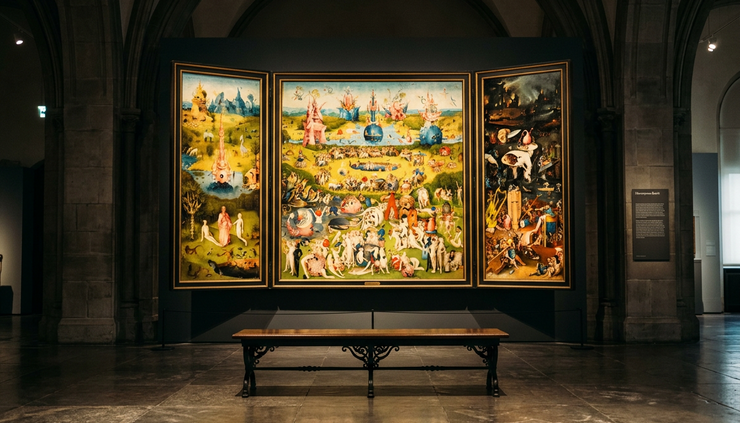
No work defines Bosch’s modern fame more than The Garden of Earthly Delights, now in the Museo del Prado in Madrid. It is a triptych, a three-part work with hinged panels, and it may be the most debated image of the Northern Renaissance.
When closed, the outer wings show the world as a pale, glassy sphere, often understood as creation before the full emergence of life. When opened, the triptych explodes into colour. The left panel presents Eden, with God, Adam and Eve in a strange landscape filled with animals and unusual rock forms. The central panel shows a vast field of nude figures, birds, berries, pools and curious structures. The right panel depicts hell, a dark realm of punishment, fire, broken bodies and monstrous inventions.
The central panel is the great mystery. Is it a vision of humanity before the Fall, a false paradise of sensual pleasure, a warning against lust, or an imagined world where desire has escaped all restraint? Scholars continue to disagree. That uncertainty is part of the painting’s power.
Bosch does not give a simple moral diagram. The central garden looks beautiful at first. Its colours are delicate. Its figures move with ritual calm. Yet the scene also feels unstable. People gather inside transparent spheres, ride animals, carry giant fruit and perform actions whose meanings remain just out of reach. Pleasure appears weightless, but also fragile. It may be innocent, foolish or dangerous.
The right panel removes all ambiguity. Hell is not only punishment after death. It is a revelation of what desire becomes when it loses form and measure. Musical instruments crush or bind the damned. A bird-headed monster devours humans and excretes them into a pit. A pale figure known as the “tree-man” gazes back with unforgettable melancholy. Bosch turns the human body into a site of consequence.
The painting’s lasting difficulty lies in its refusal to settle into one meaning. It may teach orthodox morality, yet it does so through images so inventive that they seem to outrun doctrine. It warns against sensual excess, yet it also studies sensuality with almost obsessive fascination. It pictures damnation, yet its imaginative intensity has drawn viewers back for centuries.

The Haywain Triptych turns society into a procession of folly
The Haywain Triptych offers one of Bosch’s clearest moral images, although its details remain complex. The central panel shows a huge cart of hay moving through the world. Around it, people from many ranks of society grasp, fight, climb and scheme to seize their share. The hay becomes a symbol of earthly goods, wealth and vanity. Everyone wants it, and no one can keep it.
The subject draws on a traditional proverb about the world as a hay cart from which each person takes what they can. Bosch turns that proverb into a sweeping social vision. Peasants, clergy, merchants and nobles all participate. Even figures of high status appear caught in the same appetite as the poor. The point is not that one class is uniquely corrupt. The point is that human folly is universal.
The triptych’s structure deepens the warning. The left panel shows the origin of sin, with scenes associated with the fallen angels, the creation of Eve and the expulsion from Eden. The central panel shows humanity chasing worldly gain. The right panel leads to hell, where demons construct a tower-like infernal space and the moral disorder of the centre reaches its end.
Bosch’s genius lies in the way he makes allegory feel animated. The hay cart is not an abstract symbol floating in space. It moves. People press towards it. Some are crushed by wheels. Others make music, flirt, beg, cheat or climb. Christ appears above, often unnoticed, displaying wounds and calling attention upwards. Below, society keeps looking sideways, backwards and down.
The painting does not simply condemn greed. It presents a whole moral ecology. Desire spreads through imitation. Crowds create momentum. Social rank fails to protect the soul. Religious symbols can be present while spiritual attention is absent. Bosch uses a crowded public spectacle to expose private disorder.
The Temptation of Saint Anthony makes inner struggle visible
The subject of Saint Anthony gave Bosch the ideal theme for his imagination. Anthony was a desert saint who resisted demonic temptations, and his story was widely known in medieval Christianity. Artists had long depicted him surrounded by devils, but Bosch transformed the theme into a vast theatre of spiritual pressure.
In The Temptation of Saint Anthony, a major version of which is held in Lisbon, the saint appears within a world of ruins, fires, hybrid monsters and deceptive rituals. Demons do not arrive as simple horned villains. They appear as fish with legs, birds with armour, strange machines, half-human bodies and comic horrors. The scene is frightening, but also strangely witty. Evil in Bosch is often absurd before it is terrifying.
Anthony’s power lies in his stillness. Around him, the world mutates. Buildings collapse or burn. Creatures swarm. False worship and grotesque ceremonies unfold. The saint remains the moral centre, fragile yet steady. Bosch turns temptation into something more complex than bodily desire. It becomes distraction, illusion, fear, spectacle and spiritual fatigue.
The painting speaks to a late medieval understanding of the inner life. Temptation was not only an external test. It occurred in thought, imagination and vision. Bosch gives form to mental assault. He paints the pressure of images themselves, as if the mind could be crowded by demons, fantasies and false promises.
That idea feels startlingly modern. Bosch shows how consciousness can be invaded by forms it cannot fully control. His monsters are not random decorations. They are visual embodiments of disorder, appetite and anxiety. They make the invisible drama of conscience visible.

Bosch invented a language of dreams with moral purpose
Bosch’s art is often described as dreamlike, but the word can mislead. His paintings do not feel vague. They are astonishingly precise. A creature may be impossible, yet its feathers, shell, beak, claw or bootlace are rendered with exact care. A landscape may be imaginary, yet it follows its own internal rules. Bosch makes fantasy persuasive through detail.
His artistic language rests on several linked features.
Fantastical creatures
Bosch’s beings combine animals, objects and human fragments. They can be comic, obscene, delicate or cruel. A knife may become a body. A helmet may sprout legs. A bird may behave like a judge or executioner. These hybrids unsettle categories. They show a world where moral disorder has entered nature itself.
Dreamlike landscapes
His settings often include spires, hollow forms, burning towns, glassy pools and rock formations that resemble living organisms. Space opens into zones of action rather than unified perspective. The eye travels from scene to scene, collecting clues. Looking becomes a kind of pilgrimage.
Allegorical narratives
Bosch did not paint single moments in a simple way. He built layered narratives. Creation, sin, temptation, social folly and judgement may appear across one work. The viewer must connect episodes, objects and gestures. This makes his paintings intellectually demanding as well as visually compelling.
Extraordinary attention to detail
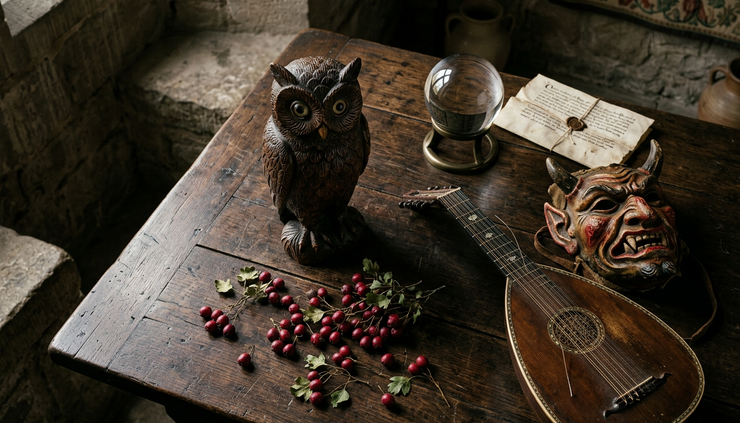
Small details carry moral weight. A funnel worn as a hat may suggest foolishness. An owl may imply wisdom, darkness or hidden knowledge, depending on context. Fruit may suggest pleasure, fertility or decay. Instruments, animals and everyday tools shift into symbolic roles.
Bosch’s symbols rarely behave like a fixed code. They gather meaning from placement, scale and relation. That is why his works resist final explanation. They act less like puzzles with one answer and more like moral poems in visual form.
Morality and imagination are inseparable in his paintings
Bosch’s deepest subject is human behaviour under spiritual pressure. He shows people eating, drinking, flirting, grasping, marching, listening, worshipping, cheating and suffering. His figures are often tiny, but their actions matter. Each gesture participates in a larger moral order.
In this sense, Bosch belongs firmly to Christian moral art. His paintings warn against sin, vanity, lust, greed and spiritual blindness. They ask viewers to confront the possibility of judgement. Hell is not decorative spectacle. It is the end point of choices repeated until they become destiny.
Yet Bosch’s moral imagination is more subtle than simple condemnation. He understands temptation as attractive. The central panel of The Garden of Earthly Delights would not disturb viewers if it looked merely ugly. Its beauty is part of the warning. Pleasure can charm before it destroys. Folly can look communal and festive. Sin can resemble play.
This is one reason Bosch’s art continues to feel alive. He does not present human beings as monsters. He presents them as distractible, desirous, comic, vulnerable and easily misled. His demons may be grotesque, but the most troubling figures are often ordinary people doing ordinary things without spiritual awareness.
Bosch also explores society as a moral system. In The Haywain Triptych, greed is not a private failing alone. It becomes a public procession. In scenes of false devotion, violence or excess, social rituals can mask disorder. Bosch sees the crowd as both comic theatre and spiritual danger.
Imagination gives him the means to express what plain realism could not. A conventional scene of vice might instruct. Bosch’s symbolic worlds haunt. By making sin visible as nightmare, he turns ethics into vision.
His influence reaches from Surrealism to cinema
Bosch’s afterlife has been extraordinary. Later artists, collectors and scholars returned to his work because it seemed to anticipate forms of imagination far beyond his own century. His crowded dream worlds have inspired painters, writers, theatre-makers, filmmakers and designers. They offer a model for building entire visual universes.
The Surrealists found Bosch especially compelling. Artists associated with Surrealism admired images that seemed to bring unconscious desires, dreams and irrational juxtapositions into visible form. Bosch was not a Surrealist, and reading him only through twentieth-century psychology risks distorting his religious context. Still, the connection is understandable. Long before modern theories of the unconscious, Bosch painted worlds where reason falters and hidden drives take shape.
Salvador Dalí, Max Ernst and other modern artists recognised in Bosch a powerful ancestor of imaginative transformation. His hybrids, metamorphoses and impossible spaces showed that painting could do more than imitate the seen world. It could reveal the mind’s theatre.
Writers and filmmakers have also drawn from Bosch’s example. His images suggest narrative without closing it. One monster implies a story. One burning horizon implies a catastrophe outside the frame. His paintings feel cinematic because they invite scanning, zooming and montage. The viewer moves across them as if through a sequence of scenes.
Scholars remain equally fascinated because Bosch sits at the crossroads of so many fields: theology, folklore, visual culture, social satire, manuscript tradition, material technique and the history of collecting. Technical study has also deepened understanding of his working methods, including underdrawing and workshop practice. At the same time, many questions remain open.
That combination of intense visual pleasure and unresolved meaning keeps Bosch central to art history. He rewards close looking, but he never becomes exhausted by it.
The mysteries endure because the paintings refuse one answer
Few artists have generated such a wide range of interpretation. Bosch has been read as a moralist, satirist, visionary, orthodox believer, social critic, proto-surrealist and painter of private fantasies. Some older theories linked him to heretical sects or secret doctrines, though such claims require caution and have often proved difficult to support.
The challenge comes from the paintings themselves. Bosch used symbols rooted in his culture, but he rearranged them with unusual freedom. A viewer may recognise a sin, proverb or biblical theme, then encounter a detail that disrupts easy reading. His works feel coherent, but not fully translatable.
Several factors keep debate alive:
Many works have uncertain dates, attributions or workshop connections.
Bosch left no theoretical writings that explain his intentions.
Late medieval symbols often carried several meanings at once.
Later copies and versions complicate the record.
Modern viewers bring psychological, literary and secular frameworks that differ from Bosch’s own world.
This does not mean interpretation is futile. It means Bosch demands humility. The strongest readings combine historical knowledge with close visual attention. They recognise the Christian moral structure of his art while allowing for wit, ambiguity and imaginative excess.
His paintings are not riddles to be solved and put away. They are visual fields of thought. They ask viewers to look again, and then again, because meaning appears through accumulation.
Bosch remains one of art history’s great visionaries
Hieronymus Bosch endures because he made imagination serve the most serious questions of his age. He painted sin, folly, temptation and judgement, but he also painted curiosity, comedy, fear and desire. His worlds are strange because human behaviour is strange. His monsters disturb because they feel connected to recognisable impulses.
He was neither a modern sceptic nor a mere illustrator of doctrine. He was a religious artist with an unmatched capacity to invent forms for invisible states of the soul. He gave anxiety a body, temptation a landscape and moral collapse a terrifying beauty.
Centuries after his death, Bosch still defeats simple categories. He belongs to the Northern Renaissance and to the late medieval imagination. He belongs to Christian moral art and to the history of fantasy. He speaks to theologians, art historians, psychoanalysts, poets, painters and filmmakers. His work stands at the border between instruction and dream.
That is why Hieronymus Bosch The Visionary Painter of Dreams Symbols and Imagination remains more than a description. It names the lasting force of his art. Bosch transformed the painted panel into a universe where every creature, object and gesture might carry moral meaning. He showed that imagination could reveal truths that ordinary sight could not reach, and he remains one of the most original visionaries in the history of art.


Comments