



Jan van Eyck The Master of Light and Oil Painting


A single glint on a brass chandelier, a pearl of light on a convex mirror, a face built from almost invisible layers of colour: Jan van Eyck turned small details into acts of wonder.
His paintings still feel startling because they ask us to look harder. A sleeve is not just red cloth. It is wool, dye, weight, seam, fold, status, and light. A window is not just a source of brightness. It is a silent witness, shaping the room and giving every object its place. A face is not a flat likeness. It is skin, reflection, thought, and presence.
Van Eyck worked in the Northern Renaissance, far from the fresco walls and classical ruins that shaped much of Italian art. His world was one of panel paintings, courtly patrons, devotional images, trade wealth, precious materials, manuscripts, and close observation. He did not invent oil painting, despite the old myth, but he helped show what oil could do when handled with patience and precision.
That is why his work matters. Van Eyck made painting feel almost alive, not through grand gesture, but through control. He mastered light, detail, and oil in a way that changed what European painting could be.
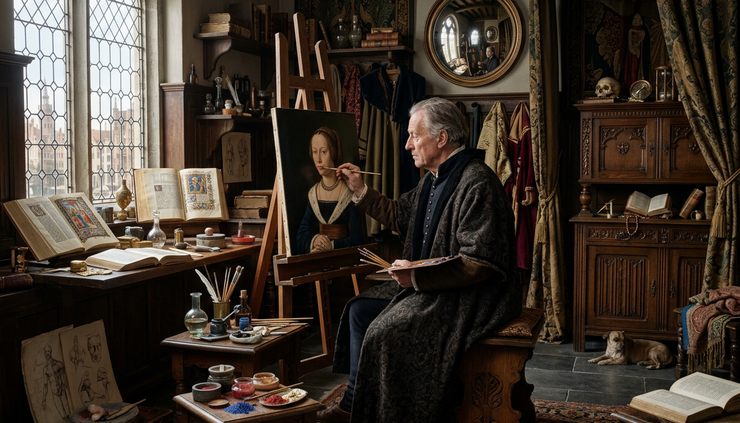
Van Eyck made light feel physical
The first thing many people notice in a Van Eyck painting is the detail. The second is the light. In truth, the two cannot be separated.
His detail works because light reveals it. Metal gleams differently from glass. Fur absorbs brightness. Polished wood holds a warmer reflection than stone. Skin has a softness that cloth does not. Van Eyck understood these differences with uncanny care.
Look at The Arnolfini Portrait, one of his best-known works. The room is modest in size, yet it feels full of visual incident. Light enters from the window at the left. It touches the heavy green dress, catches the oranges on the sill, glints on the chandelier, and crowns the small convex mirror on the back wall. Every object has a different relationship with light.
This is not simple decoration. Light organises the painting.
It tells us where to look. It gives weight and depth to the figures. It makes the room believable, even as the objects inside it carry possible symbolic meanings. The mirror reflects tiny figures, the dog stands alert, the shoes sit aside, the bed glows red, the fruit suggests wealth and perhaps innocence or temptation. Yet the painting never collapses under its own meanings because the light holds the scene together.
Van Eyck’s light is rarely theatrical in a loud sense. It does not blast across the picture. It often enters quietly, like daylight filtered through a window. This makes the painted world feel observed rather than staged.
That quietness gives his work its power. The viewer feels invited into the act of looking. The more time spent with the painting, the more it gives back.
In devotional works, the same skill takes on a spiritual force. In The Madonna of Chancellor Rolin, the Virgin and Child sit in an architectural space that opens onto a vast landscape. The figures are close enough to study, but beyond them lies a world of bridges, buildings, fields, and distant hills. Light links the sacred interior with the world outside.
The result is intimate and immense at once. Van Eyck does not separate earthly detail from divine meaning. He uses earthly detail to make the divine feel present.
Oil paint gave him time, depth, and brilliance
Van Eyck’s name is often tied to the history of oil painting. Older accounts claimed that he invented the medium. That is not correct. Artists used oil before him. What Van Eyck did was refine its possibilities and make them impossible to ignore.
Tempera, a common painting medium before oil became dominant, dries quickly and creates a more matte surface. It can produce crisp work, but it does not offer the same depth or slow blending that oil allows. Oil paint dries more gradually. It can be layered in thin, translucent films. It can create saturated colour, subtle shadows, and surfaces that seem to catch real light.
Van Eyck used these qualities with remarkable discipline.
He built forms through glazes, thin layers of colour that modify what lies beneath them. A red robe could gain depth through multiple translucent layers rather than one flat application. Flesh could shift from warm to cool with tiny adjustments. Shadows could remain luminous instead of turning dull.
Oil also helped him describe texture. The sheen of satin, the sparkle of jewels, the wetness of an eye, the grain of wood, and the cool face of polished metal all called for different handling. Van Eyck gave each surface its own behaviour.
This is one reason his paintings reward close reproduction, but they reward direct viewing even more. In person, the surface often shows a balance between smooth finish and minute craft. The image may look almost seamless from a distance, then reveal the intelligence of its making up close.
His control of oil did not make his art cold. The precision serves feeling. In portraits, oil allows him to register slight asymmetries, the set of the mouth, the angle of the gaze, and the fragile look of living skin. These details create presence.
Portrait of a Man, often called Man in a Red Turban, is a strong example. The head turns towards us with calm intensity. The red headgear folds around the skull in complex forms, but the face remains the centre. The eyes are alert. The mouth is firm. The surface is exact, yet the person does not feel like a specimen. He feels near.
That nearness changed portraiture. Van Eyck helped make the individual face a subject worthy of sustained attention.

Detail in Van Eyck is never just detail
Van Eyck’s exactness can be mistaken for showing off. It is much more purposeful than that.
His details act in several ways at once. They describe the world. They mark status. They carry religious or moral meaning. They slow the viewer down. They create trust.
A painted jewel in a Van Eyck work is not only a jewel. It may show wealth, patronage, sacred value, or courtly taste. A book may suggest learning, prayer, or authority. A mirror may point to sight, truth, vanity, divine witness, or the artist’s skill. A landscape may do more than fill space. It may connect the human scene to God’s creation.
The key is that Van Eyck does not make these objects feel like flat symbols. He gives them physical truth first. Their meaning grows out of their presence.
This is clear in the Ghent Altarpiece, created by Hubert and Jan van Eyck and completed in 1432. It is one of the great monuments of European art. Across its panels, sacred figures, donors, angels, prophets, architecture, jewels, plants, and landscape appear with astonishing care.
The central panel, often called The Adoration of the Mystic Lamb, brings together worshippers around the Lamb of God. The image is rich with Christian meaning, but what strikes many viewers is the sheer specificity of the world. Grass, flowers, brocade, faces, hair, stone, and metal all receive attention. The sacred event appears in a world that feels materially complete.
That completeness matters. Van Eyck’s art suggests that the visible world is worthy of close study because it can disclose invisible truth. The smallest thing can matter.
This approach has roots in the culture of the Low Countries in the fifteenth century. Manuscript illumination, with its love of tiny scenes and jewel-like colour, shaped the visual habits of the region. So did urban wealth, trade, fine craft, and court culture. Van Eyck brought those forms of looking into panel painting at an extraordinary level.
His detail also changes time. A quick glance cannot take in a Van Eyck. The work asks for attention. It sets a pace. A viewer moves from face to fabric, from window to mirror, from inscription to landscape, then back again. The painting becomes an experience of discovery.
This is why his art still works in an age flooded with images. It resists speed. It rewards patience.
His portraits changed how people appeared in art
Van Eyck’s portraits feel direct because they combine likeness with thought. He did not flatter people into smooth ideals. He studied them.
The faces he painted often have a reserved intensity. They do not perform emotion in an obvious way. Instead, they hold themselves. Their personalities emerge through small decisions: parted lips, steady eyes, a furrow, a shadow beneath the cheekbone, the pressure of a hand.
In Portrait of a Man, if the sitter is indeed Van Eyck himself, the effect is even more gripping. The gaze meets ours without drama. The folds of the red head covering are spectacular, but they do not distract from the face. Above, the frame includes the phrase often associated with Van Eyck, `Als ich can`, usually understood as “as I can”. It is modest and proud at once, a personal motto shaped into art.
His portraits also show how deeply he understood social identity. Clothing matters. Fur linings, rings, headwear, and fine cloth help place a sitter in the world. They are not random luxuries. They speak of class, role, taste, and ambition.
Yet the finest portraits do not reduce people to their possessions. Van Eyck’s sitters remain psychologically present. Their wealth may frame them, but it does not replace them.
This is one of his great achievements. He painted the outer signs of life and the inward pressure of being alive.
The Northern Renaissance studio was well suited to this kind of work. Panel painting allowed a controlled surface. Oil allowed slow adjustment. Patrons wanted durable images of devotion, marriage, rank, and memory. Van Eyck brought all these needs together.
His position at the Burgundian court also mattered. He served Philip the Good, Duke of Burgundy, and moved in a world where art, diplomacy, politics, and display were closely linked. Court life valued splendour, but also skill. A painter who could render gold, velvet, flesh, and sacred presence with such conviction held real prestige.
Van Eyck’s signature and inscriptions show a strong sense of authorship. In a period when many artists remained anonymous, he marked works with confidence. This does not make him modern in a simple sense, but it does show a clear awareness of artistic identity.
He was not only making images. He was making claims for what painting could do.

The studio was a place of craft, science, and symbolism
It is tempting to imagine Van Eyck simply seeing more than other artists. His eye was exceptional, but vision alone does not explain the work. His paintings come from a union of observation, materials, workshop practice, and ideas.
A fifteenth-century painter had to understand surfaces in practical terms. Wooden panels needed preparation. Pigments had to be ground. Binders mattered. Drying time affected each stage. Fine brushes were essential for small details. Mistakes could be costly.
The studio was not a romantic blur of inspiration. It was a disciplined place.
Van Eyck’s art suggests careful planning beneath its natural effect. Compositions often guide the viewer with architectural lines, windows, frames, and repeated shapes. Reflections extend the space. Objects are placed with purpose. Even the smallest elements feel considered.
This discipline sits beside curiosity. Van Eyck seems fascinated by how things appear under light. He studies reflection in mirrors and armour. He examines transparent and polished surfaces. He paints distant landscapes with the same seriousness as nearby faces.
Some writers have discussed whether optical devices played a role in early Netherlandish painting. The broader debate is complex, and there is no need to turn Van Eyck into a technician with a single trick. His achievement does not depend on a gadget. What matters is that his paintings show a mind deeply engaged with seeing.
He understood that sight is layered. We do not see an object alone. We see it through light, distance, atmosphere, material, memory, and belief.
This is why symbolic objects in his paintings rarely feel artificial. They belong to a visible world that has been carefully made believable. A candle, a lily, a book, a mirror, a fountain, or a crown can bear meaning because it first convinces the eye.
His religious paintings depend on this balance. The sacred enters the ordinary through craft. Gold is not just gold. It is splendour. Light is not just illumination. It is revelation. A face is not just a likeness. It is a soul made visible through paint.
The phrase Northern Renaissance realism can sound dry, but in Van Eyck’s hands it becomes something rich and strange. Realism does not reduce mystery. It heightens it.
His influence reached far beyond his lifetime
Van Eyck died in 1441, but his impact continued through Netherlandish painting and beyond. Artists studied his surfaces, his portrait formats, his use of oil, his inscriptions, and his ability to make detail carry meaning.
His influence can be seen in the rise of oil painting as a dominant European medium. Italian artists later embraced oil with growing interest, drawn to its depth, glow, and flexibility. The story is not a simple line from one artist to all the rest, but Van Eyck stands near the centre of the change.
Early Netherlandish painters who followed him inherited a demanding standard. After Van Eyck, a painted surface could be expected to do more. It could show texture with accuracy, create convincing light, register individual identity, and support complex symbolism.
His work also shaped how patrons thought about painting. A panel could be devotional, decorative, intellectual, and personal at once. It could record wealth and humility, prayer and power, public status and private feeling.
That mix remains part of painting’s appeal.
Van Eyck’s legacy also lives in how museums teach people to look. His paintings are often used to explain close observation, symbolism, and technique because they make these ideas visible. A viewer does not need specialist training to sense their brilliance. The first response is often simple surprise: how could paint do that?
Then comes the slower response. The eye lingers. The mind starts making connections. The material world in the painting becomes readable, but never exhausted.
This is why reproductions, even good ones, can only go so far. They help identify the image, but they flatten scale, surface, and glow. Van Eyck’s paintings are built for sustained looking. Their power grows in the presence of the object.
The Arnolfini Portrait shows his whole method in one room
If one painting had to introduce Van Eyck, The Arnolfini Portrait would be the obvious choice. It condenses many of his strengths into a single domestic interior.
The figures stand in a room filled with carefully chosen objects. The man raises his hand. The woman gathers the heavy fabric of her dress. A small dog stands between them. Shoes lie aside. Fruit rests by the window. A chandelier hangs above. At the back, the convex mirror reflects the space, including two small figures who seem to stand where the viewer stands.
The painting has produced many interpretations. Some see it as a marriage image. Others read it as a memorial, a legal witness, a display of status, or a scene with layered devotional meaning. Art historians continue to debate parts of it.
The reason it can sustain debate is that Van Eyck gives the room such density. Nothing feels careless. Everything seems available for interpretation, yet everything also exists as a believable thing.
The mirror is especially famous. Around it are tiny scenes from the Passion of Christ. In its glass, the room bends into a miniature world. The reflection expands the painting beyond the front-facing view. It also raises questions about witness, presence, and the relationship between image and reality.
Near the mirror, Van Eyck includes an inscription that can be read as “Jan van Eyck was here”. This is more than a signature. It places the artist inside the event, or at least inside the imagined space of the painting. He becomes observer, maker, and witness.
Here, light, detail, symbolism, and authorship meet.
That is Van Eyck at his strongest. He builds a world so convincing that it seems factual, then fills it with meanings that remain open.

What makes Van Eyck feel modern
Van Eyck belongs fully to the fifteenth century. His art is rooted in Christian devotion, court culture, manuscript tradition, and the social world of the Burgundian Netherlands. Yet his paintings can feel surprisingly modern because they respect the intelligence of looking.
He does not tell the viewer everything at once. He offers evidence.
A face, a room, a reflection, a landscape, and an inscription become clues. The viewer studies them, compares them, and returns to them. This suits modern habits of close reading, but it also resists modern impatience.
His art also feels modern in its attention to objects. We live among things that shape identity: clothes, rooms, books, tools, gifts, heirlooms. Van Eyck understood that objects can speak about people without speech. He also understood that material beauty can be serious.
That seriousness is easy to miss. Detail in lesser art can become clutter. In Van Eyck, detail becomes structure. It gives the image moral, social, and spiritual weight.
His portraits feel modern too because they do not depend on ideal beauty. They value particularity. A sitter’s face matters because it is specific. The person appears as this person, not a general type.
That may be Van Eyck’s most lasting gift. He convinces us that the world deserves exact attention, and that exact attention can lead to wonder.
The lasting lesson of Van Eyck’s art
Jan van Eyck changed painting by making it look harder at the world. He used oil not as a surface trick, but as a way to deepen colour, light, and presence. He used detail not as ornament, but as meaning. He used portraiture not just to record rank, but to suggest inner life.
His paintings ask for slow looking. They reward the eye that notices the small glint, the folded edge, the distant hill, the shadow under an eyelid, the reflected room inside a mirror.
The lesson is simple and demanding: precision can be poetic. Van Eyck’s art shows that careful observation does not drain mystery from the world. It reveals more of it.


Comments