



Paolo Uccello and the Geometry of Renaissance Perspective


Paolo Uccello was the painter who turned space into a problem, and then spent a lifetime trying to solve it. Born Paolo di Dono in Florence around 1397, he became one of the most curious and technically daring artists of the Early Renaissance. His nickname, “Uccello”, meaning “bird”, is usually linked to his fondness for painting animals, especially birds. Yet the name now evokes something larger: an artist whose imagination seemed to hover above ordinary vision, measuring the world from strange angles and rebuilding it through geometry.
Uccello lived at a moment when Italian art was changing with rare speed. Florence was full of sculptors, architects and painters who were rethinking the visible world. Brunelleschi had demonstrated the principles of linear perspective. Donatello was bringing weight and psychological force to sculpture. Masaccio had shown how painted figures could stand in convincing space. Uccello absorbed this atmosphere, but he followed one path with almost obsessive intensity. He wanted to understand how forms recede, how bodies turn, how objects lie across a floor, and how a painting can suggest depth on a flat surface.
That lifelong inquiry gives his art its distinctive tension. His works can look medieval in their decorative brilliance and dreamlike colour, yet they are also among the boldest spatial experiments of the 15th century. Paolo Uccello and the Geometry of Renaissance Perspective is not only a story about one painter’s style. It is a story about how Renaissance art learned to think in space.
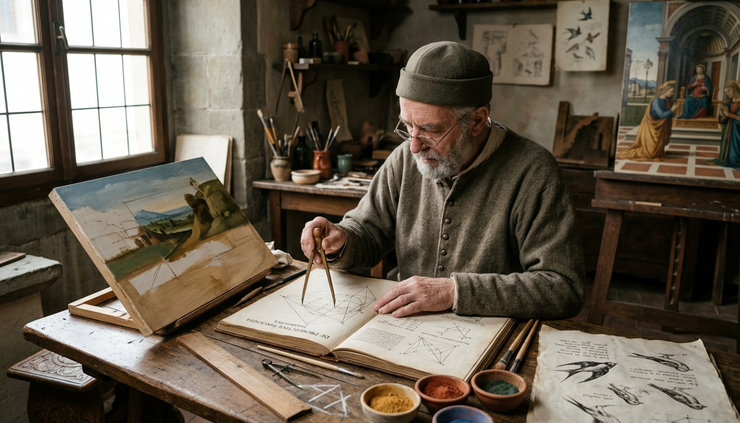
A Florentine artist formed by craft and experiment
Uccello’s early training placed him close to the centre of Florentine artistic life. As a young man, he worked in the workshop of Lorenzo Ghiberti, the sculptor responsible for the famous bronze doors of the Florence Baptistery. This mattered. Ghiberti’s workshop was not a narrow trade school. It was a place where drawing, metalwork, relief, ornament, anatomy and spatial design met. An apprentice there learned how to think through the hand, how to organise complex surfaces, and how to make figures occupy believable space.
Florence itself also gave Uccello a visual education. Churches, civic buildings and public commissions demanded art that could persuade viewers from a distance and reward close looking. Painters had to handle narrative, architecture, costume, religious meaning and social prestige. They also faced a new technical challenge: the growing expectation that pictures should no longer read only as flat arrangements of sacred signs, but as coherent worlds.
Uccello’s career moved across several types of work. He painted panel pictures, designed frescoes, and produced images for both religious and civic settings. His 1436 fresco of the equestrian monument to Sir John Hawkwood in Florence Cathedral shows his ability to combine public grandeur with optical calculation. The work imitates a sculpted monument, yet it is painted on a wall. Its plinth, horse and rider depend on careful illusion. The viewer is invited to see stone, bronze and architectural depth where there is only pigment.
This kind of visual deceit was central to Renaissance ambition. A painting could appear to open a wall, create a chapel space, stage a battle, or give a long-dead commander a public afterlife. Uccello did not simply adopt these tricks. He probed them. He explored their mechanics with an intensity that later writers turned into legend.
The Renaissance biographer Giorgio Vasari famously presented Uccello as a man so absorbed in perspective that he neglected worldly success. Vasari’s account is coloured by anecdote and moral judgement, as many of his artist biographies are. Still, it preserves something true about Uccello’s reputation. His contemporaries and successors recognised that his paintings were driven by a profound interest in geometry, measurement and visual order.
This does not mean his art is cold. Quite the reverse. Uccello’s pictures often feel uncanny because mathematical discipline and poetic fantasy exist side by side. His horses rear like carved toys. Armour glitters like metal sculpture. Lances cut across the surface like ruled lines. Landscapes recede into strange distances. Dragons, saints and soldiers inhabit spaces that are both observed and imagined.
Why perspective mattered so much in Renaissance art
To understand Uccello, one must understand the intellectual force of perspective in the 15th century. Linear perspective was more than a technical device. It offered a new way of arranging knowledge. It suggested that the visible world followed rules, that space could be measured, and that a painting could reconstruct visual experience according to rational principles.
Before the Renaissance, European artists certainly created depth. Medieval painters used overlapping figures, hierarchical scale, patterned grounds and architectural framing. These methods were powerful, but they did not usually describe space as a unified optical system. In Florence, artists began to ask different questions:
How does a tiled floor shrink as it recedes?
Where should parallel lines appear to meet?
How does a body look when seen from below?
How can a painting align with the viewer’s position?
Can geometry make sacred or historical scenes feel physically present?
For architects, perspective helped imagine and communicate buildings. For painters, it transformed the panel or wall into a measured field. For humanists and theorists, it linked art to mathematics, optics and the study of nature.
Uccello entered this conversation with unusual zeal. He did not always use perspective in the calm, balanced manner later associated with High Renaissance art. Instead, he often made perspective visible as a force within the composition. Fallen lances point towards recession. Broken weapons mark intervals on the ground. Horses turn in difficult positions. Bodies lie foreshortened across the picture plane. The scene becomes a demonstration of spatial thinking.
His art shows that Early Renaissance perspective was not yet a settled formula. It was an open field of experiment. Painters were testing what could be done, what looked convincing, what looked strange, and how mathematical order might coexist with narrative excitement.
This is why Uccello remains so compelling. He did not treat perspective as a neutral background system. He made it part of the drama. Space itself becomes active in his paintings. It directs force, controls movement and intensifies the viewer’s experience.

The Battle of San Romano and the spectacle of ordered chaos
Uccello’s best-known achievement is The Battle of San Romano, a set of three large panels representing the Florentine victory over Sienese forces in 1432. The paintings are now divided between the National Gallery in London, the Uffizi in Florence and the Louvre in Paris. Their original arrangement and exact dating have been much discussed, but their importance is beyond doubt. They are among the most extraordinary battle images of the Early Renaissance.
At first glance, the panels dazzle as spectacle. Armoured horsemen charge through crowded fields. Lances rise, fall and splinter. Horses rear and twist. Standards flutter. Figures strike theatrical poses, frozen in moments of conflict. The scenes are full of luxury: polished armour, patterned fabrics, decorative harnesses and brilliant colour.
Yet beneath this pageantry lies a rigorous structure. Uccello organises battle through geometry. Lances and spears create diagonals that cut across the field of vision. Fallen weapons lie on the ground like perspective markers. Broken shafts recede in measured sequence. The battlefield becomes a kind of gridded stage.
This is one of Uccello’s most original ideas. War is usually associated with confusion, violence and disorder. Uccello converts it into an experiment in visual control. The viewer sees chaos, but also recognises pattern. Bodies collide, yet the composition holds them in a precise spatial net.
The ground as a measuring surface
In the London panel, often known as Niccolò Mauruzi da Tolentino at the Battle of San Romano, the foreground is scattered with fragments: a fallen soldier, broken lances, armour and weapons. These are not incidental details. They help establish depth. The fallen objects lie at angles that guide the eye into the picture.
The receding lances are especially striking. They serve both narrative and mathematical purposes. As weapons, they belong to the battle. As lines, they test perspective. They remind the viewer that the picture is built from calculated directions.
Uccello’s handling of the horse bodies is equally ambitious. Horses appear from the side, from three-quarter angles, in rearing movement and in fallen positions. Each pose presents a spatial problem. How does a barrel-shaped body turn in depth? How do legs overlap? How does armour reflect volume? Uccello’s answers are not always naturalistic by later standards, but they are visually gripping. The horses often seem like sculptural forms arranged across a stage.
The decorative and the scientific
One reason The Battle of San Romano remains fascinating is that it refuses to choose between ornament and analysis. The surface is richly decorative, almost courtly in its love of colour and pattern. At the same time, the structure reveals sustained mathematical curiosity.
This dual character places Uccello between worlds. He inherited the elegance and stylisation of late Gothic art, with its taste for splendid surfaces and ceremonial display. He also embraced the Renaissance desire to map, measure and rationalise space. The result is neither purely medieval nor fully classical. It is something more unusual: a vision of battle as both pageant and diagram.
The paintings also show Uccello’s theatrical imagination. The action often appears suspended, as if the battle has been paused so the viewer can inspect its spatial construction. This stillness gives the panels their dreamlike force. They do not read like documentary images of warfare. They read as visual inventions, staged to explore movement, depth and order.
Saint George and the Dragon and the geometry of the marvellous
Uccello’s Saint George and the Dragon offers a different kind of experiment. The subject was familiar: Saint George rescues a princess by confronting and defeating a dragon. Medieval and Renaissance viewers knew the story well. It combined Christian virtue, chivalric bravery and the defeat of evil. Uccello turned it into an image where fantasy and geometry meet.
Several versions or related treatments of the subject are associated with Uccello, with the National Gallery in London holding one of the most famous. The painting presents a strange and memorable scene. Saint George charges from one side on a white horse. The dragon emerges near its cave. The princess stands nearby, holding the creature on a slender lead. A storm gathers in the sky.
The composition is not simply narrative. It is spatial theatre. The dragon’s cave opens like a dark geometric aperture in the rocky background. The saint’s lance forms a strong diagonal across the scene, connecting rider, horse and monster. The princess stands upright and still, creating a counterpoint to the motion of the attack. The ground plane, the cave, the coastline and the sky all contribute to a space that feels lucid and strange at once.

A dragon in a measured world
The dragon is a creature of imagination, but Uccello places it in a constructed space. Its wings, claws and curling tail create angular rhythms. Its cave gives depth to the scene. The lance turns the saint’s act into a line of force. Even the storm cloud can be read as part of the painting’s spatial drama, a spiral of natural energy above a carefully staged encounter.
This is where Uccello differs from artists who used perspective only to support believable settings. For him, geometry could intensify the unreal. It could make a miracle or legend more vivid by giving it a precise visual structure. The marvellous becomes clearer because it has been measured.
In Saint George and the Dragon, observation, design and fantasy are inseparable. Uccello studied bodies, animals and spatial recession, yet he used this knowledge to invent a world that no one could have seen. His art is scientific in method, but poetic in result.
Frescoes, monuments and the architecture of illusion
Uccello’s interest in perspective appears with particular clarity in his fresco work. Fresco demanded planning, speed and confidence. Since the artist painted into wet plaster, large compositions had to be organised carefully in advance. This suited Uccello’s analytic mind. A fresco wall could become a testing ground for illusion.
His equestrian monument to Sir John Hawkwood in Florence Cathedral is one of the finest examples. Hawkwood was an English mercenary commander who served Florence. Uccello represented him as if he were commemorated by a sculpted monument on a classical plinth. The horse and rider stand in solemn profile, raised above the viewer. The work simulates public sculpture, but it remains painting.
The illusion is complex. Uccello had to reconcile two viewpoints: the viewer looking up from the cathedral floor and the imagined monument seen from a more controlled angle. The plinth suggests depth and mass. The horse has monumental stillness. The rider appears dignified, remote and civic rather than violently heroic.
This work matters because it shows Uccello applying perspective to public memory. Geometry does not merely create depth. It creates authority. The painted monument claims space within the cathedral, as if Florence had transformed military service into lasting civic form.
The Green Cloister and the drama of scale
Uccello also worked on frescoes for the Green Cloister of Santa Maria Novella in Florence, including scenes from Genesis, traditionally associated with works such as The Creation and Fall and The Flood. These frescoes, painted in a restricted greenish palette known as terra verde, have suffered over time, but they remain central to understanding his ambition.
In these works, Uccello faced large narrative spaces. He had to organise many figures, architectural forms and episodes within a single field. The scenes reflect his interest in recession, scale and complex staging. Architecture often frames human action. Figures gather, move and struggle within constructed environments. Space does not sit passively behind the story. It shapes the story.
The Flood scenes are especially powerful because they combine human drama with structural design. Bodies and vessels occupy difficult positions. Groups press into space. The catastrophe unfolds through mass, angle and recession. Uccello’s geometry does not diminish the emotion of the subject. It gives the disaster a terrifying order.
Studies of form and the mazzocchio
One of the forms often linked to the Renaissance study of perspective is the mazzocchio, a faceted ring-shaped headpiece. Artists used it as a demanding exercise because it required the rendering of a complex object turning in space. Uccello is closely associated with such problems of form. Whether in drawings, workshop practice or painted structures, he explored how geometric bodies could be rotated, foreshortened and clarified.
The appeal of the mazzocchio lies in its difficulty. It is not a natural landscape or a simple box. It is a patterned solid with many planes. To draw it convincingly, an artist must understand structure beneath surface. Uccello’s fascination with this kind of form reveals his deeper ambition. He wanted painting to grasp the hidden order of objects.
This helps explain the sometimes crystalline quality of his figures and animals. They can seem assembled from facets, arcs and volumes. Even when he paints a horse or dragon, one senses the geometric skeleton inside the image.
Observation, imagination and scientific thinking
Uccello’s art belongs to a Renaissance culture that increasingly valued observation. Artists studied anatomy, plants, animals, light, architecture and ancient sculpture. Yet observation alone does not explain his achievement. Uccello was not simply copying what he saw. He was transforming sight into systems.
His paintings ask how vision works. They test what happens when objects recede, when lines converge, when bodies lie across the viewer’s field, and when imagined scenes are built according to measured rules. In this sense, Uccello’s work shares a spirit with scientific inquiry, even though it belongs fully to art.
He worked before the later Renaissance union of art and science reached its most famous expression in Leonardo da Vinci. Uccello’s approach is less anatomical and less empirical than Leonardo’s, but it is no less experimental. He pursued a specific problem with rare persistence: how can a flat surface produce the sensation of organised space?
The answer, in his art, is never only technical. Geometry becomes expressive. Foreshortening can make a fallen soldier feel startlingly present. Receding weapons can turn battle into rhythm. A dark cave can make a dragon’s body feel more threatening. A painted plinth can transform a wall into a civic monument.
This is why Uccello is often considered one of the great experimental artists of the Renaissance. He accepted the risks of visible experiment. Some passages may appear rigid, artificial or theatrical, but that artificiality is part of the work’s fascination. He shows the act of construction. He lets the viewer sense the calculation behind the image.

How Uccello changed the language of painted space
Uccello did not invent perspective by himself, nor did he resolve all its challenges. Renaissance perspective developed through many artists, architects and theorists, including Brunelleschi, Masaccio, Alberti and Piero della Francesca. Uccello’s importance lies elsewhere. He expanded the imaginative possibilities of perspective.
He showed that mathematical space could animate subjects beyond architectural interiors. It could structure battle, legend, monument and sacred history. He also showed that geometry could be dramatic rather than dry. In his hands, perspective became a source of visual surprise.
His influence is best understood as part of a wider transformation rather than a simple chain of direct imitation. Later artists inherited many of the problems that obsessed him:
The foreshortened body seen from a difficult angle
The battlefield or crowd organised in depth
The use of architecture to control narrative space
The tension between decorative surface and spatial illusion
The relation between mathematical design and emotional effect
Piero della Francesca would bring a calmer and more luminous order to perspective. Leonardo would join visual study to anatomy, optics and motion. Mantegna would push foreshortening towards startling illusion. Later painters and stage designers would use perspective to create architectural fantasies, theatrical spaces and complex urban views.
Uccello stands near the beginning of this story as an artist who made the problem visible. He did not hide the scaffolding of perspective. He celebrated it. His pictures often seem to say: look at what space can do.
That attitude shaped the growth of Renaissance painting. The picture was no longer only a surface for sacred or historical figures. It became an arena for thought. The painter could compete with the architect, the mathematician and the philosopher. A panel could become a laboratory.
Why Paolo Uccello still matters
Uccello’s reputation has shifted across the centuries. Some viewers have admired his technical daring. Others have found his figures stiff or his spaces artificial. Modern audiences often respond strongly to the very qualities that earlier critics treated with caution: the strangeness, the tension, the almost abstract force of his compositions.
His paintings speak with unusual clarity to later visual culture because they reveal the structure behind illusion. Designers, architects, animators and painters still face versions of Uccello’s questions. How does one organise space? How does a line direct attention? How can a flat surface suggest depth, speed or weight? How can calculation serve imagination?
In architecture, perspective remains a tool for projecting possible spaces. In design, grids and geometry shape visual communication. In film and digital art, constructed worlds depend on spatial logic. Uccello’s methods belong to a 15th-century workshop, yet his questions remain alive.
His work also reminds us that Renaissance art was not a smooth march towards perfect naturalism. It was a field of trial, error, boldness and obsession. Uccello’s paintings can feel odd because they preserve the excitement of discovery. They show an artist testing rules before those rules became academic habits.
The finest works of Paolo Uccello are not only beautiful images. They are records of thinking. In The Battle of San Romano, he turns combat into a measured spectacle. In Saint George and the Dragon, he gives fantasy a geometric spine. In the Hawkwood fresco, he makes paint imitate monument and civic memory. In his fresco cycles and perspective studies, he treats space as both artistic challenge and intellectual adventure.
Paolo Uccello remains important because he widened the ambitions of painting. He helped show that art could investigate the world as well as represent it. His geometry was never merely a set of rules. It was a form of wonder, a way to make the visible world newly strange and newly intelligible.
For that reason, his legacy continues to reach beyond the museum. Every artist who builds depth from line, every architect who imagines space through projection, and every designer who turns structure into visual pleasure shares something with Uccello’s restless pursuit. He looked at painting and saw not a flat panel, but a universe waiting to be measured.


Comments