



Sandro Botticelli and the Poetry of Renaissance Beauty

Updated: 7 days ago
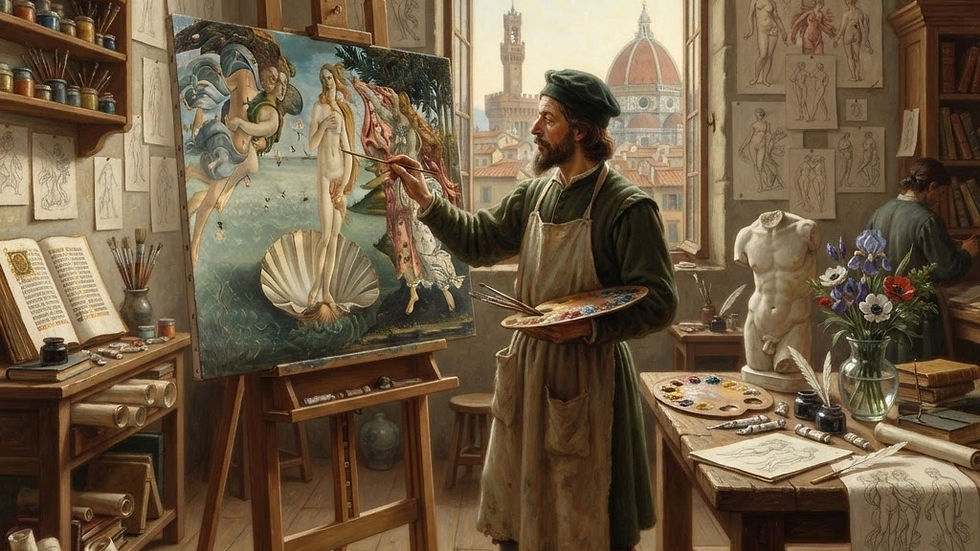
Few artists have given beauty a form as memorable as Sandro Botticelli. His Venus rises from the sea with the stillness of a vision. His Primavera gathers gods, nymphs and winds in an orange grove where every gesture seems to carry a hidden meaning. His figures do not simply inhabit painted worlds. They appear to move through thought, music and myth.
Born Alessandro di Mariano di Vanni Filipepi in Florence around 1445, Botticelli became one of the defining painters of the Italian Renaissance. His nickname, Botticelli, meaning “little barrel”, likely came through his family. He trained in Florence, absorbed the city’s artistic ambitions, and worked for patrons connected with the Medici circle. By the time of his death in 1510, his reputation had changed with fashion and politics. Centuries later, it would return with extraordinary force.
Today Botticelli stands among the most celebrated painters in Western art. His works became icons of beauty, mythology and poetic imagination because they offer more than elegant surfaces. They translate ideas into rhythm, line and expression. They reveal a Renaissance mind fascinated by antiquity, faith, love, philosophy and the mystery of human desire.

Florence shaped Botticelli’s imagination
Botticelli’s career cannot be separated from Florence. In the fifteenth century, the city was a centre of banking, civic pride, religious intensity and artistic experiment. Wealthy families commissioned chapels, altarpieces, portraits and objects for domestic devotion. Guilds supported public art. Scholars translated ancient texts. Poets, philosophers and patrons discussed Plato, Ovid, Virgil, Dante and Christian theology with equal seriousness.
Florence did not treat art as decoration alone. Images carried social prestige, moral teaching, intellectual ambition and political meaning. A painting could celebrate a marriage, honour a family, express devotion, or display a patron’s learning. Botticelli learned to work within this demanding culture, where beauty often needed to speak in several languages at once.
He probably trained with Fra Filippo Lippi, whose tender Madonnas and soft modelling left a clear mark on Botticelli’s early work. From Lippi, he learned grace, delicacy and emotional refinement. He also absorbed lessons from Florentine draughtsmanship, especially the belief that line could organise both the body and the mind. In Florence, drawing was not a preliminary skill only. It was the foundation of vision.
Botticelli’s early works show this training clearly. The faces are refined, the figures slender, the gestures carefully measured. Yet he soon developed a voice of his own. While some Renaissance artists pursued volume, anatomy and spatial depth with increasing force, Botticelli gave special power to contour. His line does not merely enclose a figure. It animates it.
The Medici world also mattered. Botticelli received commissions from patrons linked to this powerful family, whose circle encouraged the study of classical literature and philosophy. This environment helped create the conditions for paintings such as Primavera and The Birth of Venus. These works reflect a culture in which ancient mythology could be revived not as pagan ornament, but as a vehicle for moral and spiritual thought.
Humanism lay at the centre of this world. Renaissance humanists studied classical texts not to reject Christianity, but to expand the understanding of ethics, beauty, history and human potential. The ancient world offered stories, forms and ideals that could be reimagined for a Christian age. Botticelli became one of the artists best able to turn that intellectual ambition into visible poetry.
Botticelli made line speak like poetry
Botticelli’s style is instantly recognisable. His figures are graceful, elongated and inward-looking. Their bodies often seem lighter than flesh, as if shaped by breeze, music or thought. Drapery flows around them in rippling folds. Hair becomes a pattern of living lines. Movement is elegant rather than muscular. Emotion often arrives through a lowered gaze, a tilted head, or the delicate tension of a hand.
This is not a lack of skill in naturalism. Botticelli could model form, construct space and organise complex scenes. His genius lies in choosing a more lyrical path. He made beauty expressive through rhythm.
Several features define his art:
Flowing contour
Botticelli’s outlines create visual music. The curve of a shoulder, the fall of a robe and the turn of a neck often matter as much as physical weight.
Refined composition
His scenes feel carefully staged, with figures placed like notes in a measured arrangement. Even crowded works keep a sense of balance.
Idealised beauty
Faces often carry a dreamlike regularity. They are not portraits of ordinary life, but heightened images of grace.
Elegant movement
The bodies rarely strain. Even when a scene includes pursuit, wind or conflict, Botticelli gives it a poised, almost ceremonial quality.
Emotional restraint
His figures often seem thoughtful rather than dramatic. This restraint allows viewers to sense desire, melancholy, reverence and longing beneath the surface.
His use of tempera also shaped the effect. Tempera, made with pigment and egg binder, suited crisp detail and luminous colour. Botticelli used it to create surfaces of extraordinary clarity. His paintings do not depend on thick texture. Their power comes from precision, rhythm and atmosphere.
In his religious works, this style creates tenderness and devotion. In his mythological paintings, it gives ancient stories a refined psychological charge. The result is a form of beauty that feels both decorative and profound. Botticelli’s figures persuade through elegance, but they remain memorable because they seem to carry inner life.

Myth became visual poetry in his masterpieces
Botticelli’s fame rests above all on his mythological paintings. These works transformed ancient stories into images of rare psychological and cultural richness. They belong to the Renaissance rediscovery of classical antiquity, yet they do not feel archaeological. Botticelli’s mythology is not a cold revival of the past. It is a living language of beauty, love, thought and moral aspiration.
The Birth of Venus presents beauty as revelation
The Birth of Venus, painted in the 1480s, is among the most recognisable images in art. Venus stands on a shell at the edge of the sea. The wind gods blow her towards land. A female attendant waits with a flowered cloak. The goddess covers herself modestly, her long hair flowing around her body in golden strands.
The scene draws on classical sources, especially ancient accounts of Venus rising from the sea. Yet Botticelli does not present the goddess as a robust physical presence. She is pale, elongated and still. Her posture recalls antique sculpture, but her expression is inward and tender. She arrives as an image of beauty born into the world, fragile and radiant at once.
The symbolism works on several levels. Venus represents love and physical beauty, but Renaissance viewers could also understand her as a sign of higher beauty. In a Neoplatonic reading, the sight of earthly beauty could lead the mind towards divine beauty. The painting’s serene mood supports this idea. Venus is not simply an object of desire. She becomes a figure through whom desire may be refined.
The painting’s power also lies in its simplicity. The sea is stylised. The shore is quiet. The figures are few. Everything directs attention to Venus, whose body forms a pale vertical presence against the cool space around her. Botticelli creates an image that feels almost suspended between narrative and icon.
Primavera gathers love, nature and philosophy
Primavera is more complex and mysterious. Set in a grove of orange trees, the painting brings together a group of mythological figures commonly identified as Mercury, the Three Graces, Venus, Cupid, Flora, Chloris and Zephyrus. The scene has inspired many interpretations because Botticelli seems to combine poetry, philosophy, seasonal imagery and courtly love.
On the right, Zephyrus pursues Chloris, who transforms into Flora, scattering flowers. At the centre stands Venus, calm and dignified, beneath Cupid’s blindfolded aim. To the left, the Three Graces dance with interlaced hands while Mercury turns away, lifting his staff towards the clouds.
The painting can be read as a celebration of spring, fertility and marriage. It may have been connected to a Medici wedding. Yet its meaning reaches further. The movement from Zephyrus’s pursuit to Flora’s flowering presence suggests transformation. Desire becomes generative. Nature becomes culture. Physical attraction enters a larger order of harmony.
Venus, placed at the centre, governs the scene. She does not dominate by action, but by balance. Her presence gives the composition moral and emotional order. The Three Graces embody refinement and exchange. Mercury, at the edge, may suggest reason, eloquence or the clearing of mental clouds. The whole painting acts like a philosophical poem, asking how love moves from appetite to beauty, and from beauty to wisdom.
The surface is dazzling in its detail. Hundreds of plants and flowers appear across the meadow. Yet the intellectual structure remains controlled. Botticelli turns a mythological gathering into an image of cultivated desire.
Venus and Mars turns love into gentle conquest
In Venus and Mars, Botticelli treats mythology with wit and elegance. Mars, the god of war, sleeps deeply while Venus reclines awake beside him. Small satyrs play with his armour, one even blowing into a shell near his ear. The god of war lies helpless, disarmed by love.
The painting likely belonged to the world of marriage imagery. Its message may suggest that love conquers aggression, or that harmony softens conflict. Venus appears alert and composed, while Mars is unconscious and vulnerable. The contrast is clear, but Botticelli avoids crude comedy. The scene remains graceful, even when playful.
Here again, classical myth becomes more than story. It becomes an image of human behaviour. Desire pacifies violence. Beauty changes power. The painting condenses a moral idea into a scene of refined humour.
Religious works reveal another side of his vision
Botticelli’s mythology often attracts the greatest attention, but his religious paintings are essential to understanding him. Works such as Madonna of the Magnificat, The Adoration of the Magi, The Annunciation and Mystic Nativity show his range as a painter of Christian subjects.
In his Madonnas, tenderness and solemnity coexist. The Virgin often appears beautiful, but also grave, as if aware of future suffering. Child figures are delicate rather than merely sweet. Angels gather with lyrical grace. The devotional image becomes a space for contemplation.
The Adoration of the Magi also shows Botticelli’s engagement with patronage and portraiture. Members of the Medici circle appear among the worshippers, linking sacred history with contemporary Florence. The scene honours both faith and civic identity.
His later Mystic Nativity is more intense and unusual. Painted after the political and religious turmoil associated with Savonarola’s Florence, it includes a heightened spiritual mood and apocalyptic feeling. Botticelli’s late work suggests an artist responding to a changing city, one in which humanist elegance met powerful calls for moral reform.

Neoplatonism gave beauty a spiritual charge
To understand Botticelli’s mythological art, it helps to understand the philosophical climate around him. Renaissance Florence fostered renewed interest in Plato and later Platonic thought. Thinkers associated with the Medici circle, including Marsilio Ficino, explored the relationship between love, beauty, the soul and the divine. Their ideas did not produce a single fixed programme for Botticelli’s paintings, but they shaped the intellectual air he breathed.
Neoplatonism proposed that beauty in the visible world could awaken the soul. The attraction one feels before a beautiful body, a harmonious proportion or a noble action could become a first step towards higher understanding. Love, in this view, need not remain merely sensual. It could educate desire.
This helps explain the strange power of Botticelli’s Venus. She is clearly beautiful in earthly terms. Yet she is also distant, still and contemplative. Her body invites attention, but her expression refuses simple possession. She appears as an image through which physical beauty points beyond itself.
In Primavera, the same idea becomes more complex. Desire appears in different states. Zephyrus expresses urgency. Flora represents flowering abundance. The Graces embody harmony and social refinement. Venus presides over the scene as a civilising force. Mercury may point towards intellectual clarity. The painting can be seen as a journey from instinct to order, from nature to cultivated love.
Botticelli’s art reflects Renaissance humanism in this delicate balance. Humanism did not merely celebrate the individual in a modern sense. It valued education, eloquence, moral formation and the recovery of ancient wisdom. Botticelli’s paintings suggest that myth could teach, not through blunt instruction, but through beauty arranged with thought.
His figures often seem suspended between body and spirit. They have weight, yet they appear almost weightless. They occupy physical settings, yet they belong to symbolic space. This tension gives the paintings their lasting fascination. Botticelli does not ask viewers to choose between earthly beauty and spiritual aspiration. He shows how one might lead towards the other.
That vision also explains the emotional tone of his art. Even his most beautiful figures often carry melancholy. Venus does not smile triumphantly. The Graces appear absorbed. Madonnas look tender and sorrowful. Beauty, for Botticelli, is rarely carefree. It is touched by longing, vulnerability and awareness. This emotional complexity keeps the works from becoming mere ornament.
Botticelli changed the memory of the Renaissance
Botticelli’s contribution to Renaissance painting is not only a matter of famous pictures. He expanded the expressive possibilities of line, myth and poetic composition. In an age rich with technical discovery, he reminded art that intellectual depth and decorative grace could strengthen each other.
He also helped define a specifically Florentine mode of elegance. Where Leonardo explored sfumato and the mysteries of perception, and where Michelangelo pursued heroic anatomy, Botticelli cultivated rhythm, surface and ideal form. His approach was different, not lesser. He gave Renaissance art one of its most lyrical voices.
His influence can be seen in several lasting achievements.
He made classical mythology central to Renaissance painting. Ancient stories had appeared in art before, but Botticelli gave them unprecedented poetic authority in large-scale secular works. He showed that mythological subjects could carry learning, beauty and moral seriousness.
He created images that work like poems. His paintings invite interpretation, but they also resist final decoding. Their meanings unfold through mood, gesture and arrangement. This openness helps explain their modern appeal.
He gave visual form to ideal beauty. Botticelli’s Venus became a lasting model of grace, not because she represents anatomical perfection, but because she combines modesty, vulnerability and radiance.
He joined private patronage with public imagination. Many of his works emerged from elite Florentine circles, yet they now belong to global visual culture. Their images appear in museums, books, fashion, film, design and popular memory.
Botticelli’s reputation did not remain constant. After his death, later tastes favoured other qualities. The High Renaissance preference for monumental balance and physical grandeur made his linear delicacy seem less central. By the nineteenth century, critics and artists, including those associated with the Pre-Raphaelite movement, helped revive admiration for him. They recognised in his art a combination of purity, longing and decorative beauty that spoke powerfully to their own age.
That revival shaped the modern Botticelli. Today, The Birth of Venus and Primavera are not merely famous museum works. They have become visual shorthand for Renaissance beauty itself. Yet their familiarity should not dull their strangeness. These paintings remain unusual, refined and intellectually rich. They reward close looking because they are more than images of beauty. They are meditations on what beauty does to the mind.

Botticelli also continues to influence creative fields beyond painting. Designers respond to his flowing contours and controlled ornament. Fashion often returns to his drapery, hair and pale harmonies. Illustrators admire his ability to turn narrative into symbolic gesture. Film-makers and photographers echo his stillness, frontal grace and dreamlike staging. His art offers a language of beauty that remains adaptable because it is built on rhythm rather than rigid realism.
The continuing power of Sandro Botticelli and the Poetry of Renaissance Beauty lies in this union of sensual presence and intellectual suggestion. His paintings offer pleasure at first sight, then deepen through reflection. They make ancient mythology feel personal. They make philosophy visible. They show that beauty can be decorative, emotional and metaphysical at the same time.
Botticelli’s world was rooted in fifteenth-century Florence, with its patrons, workshops, poets, scholars and religious anxieties. Yet his art reaches far beyond that setting. Venus still rises from the sea with impossible calm. The Graces still turn in their measured dance. Flora still scatters flowers as if spring itself had become human. These figures endure because Botticelli gave them the quality of thought made visible.
His achievement was not to copy antiquity, nor simply to flatter Renaissance taste. It was to transform inherited stories into images of inward life. He painted beauty as a force that moves through the senses towards memory, desire and spirit. That is why Sandro Botticelli continues to captivate audiences worldwide. His poetic vision reminds artists, designers and creative thinkers that grace can carry meaning, and that a single line, drawn with intelligence and feeling, can still change how the world imagines beauty.


Comments