


Form Follows Perception: The Philosophy of High-End Product Design

A chair can hold the body. A great chair changes the room.
That’s the difference high-end product design has to confront. Function matters, but function alone doesn’t explain why some objects feel permanent, why a lamp can alter a corner, or why a table can create a sense of ceremony before anyone sits down.
The best industrial design works on two levels at once. It serves the body with precision. It also shapes perception. It carries an idea about weight, time, touch, movement, restraint, pleasure, and care.
This is where philosophy in product design becomes more than a slogan. It becomes a method. High-end objects ask a clear question: what should use feel like?

Utility is only the starting point
Industrial design began with a hard promise. Make objects that work. Make them repeatable. Make them clear. Remove excess. Respect use.
That promise still matters. A vessel must pour cleanly. A handle must meet the hand. A seat must support the body. A door pull must make its action plain before touch. Bad function ruins good form fast.
But high-end design doesn’t stop at usefulness. It treats function as the base layer. Then it builds emotional force.
A well-designed object can create calm, tension, delight, authority, intimacy, or ritual. It can slow the hand. It can invite a pause. It can make a room feel grounded. It can make daily action feel considered.
This doesn’t mean decoration. Decoration can help, but emotional design runs deeper. It lives in proportion, surface, temperature, sound, and resistance.
Think about the difference between these actions:
Pulling open a light, hollow drawer
Pulling open a drawer with quiet weight and a smooth, controlled travel
Holding a thin plastic cup
Holding a dense ceramic cup that keeps warmth in the palm
Sitting on a chair that merely fits the body
Sitting on one that changes posture without forcing it
Each object performs a task. Only some change the experience of the task.
High-end design understands that the body reads objects before the mind names them. The angle of a backrest communicates permission. A rounded edge says approach. A severe edge creates distance. A low table pulls people inward. A tall narrow object claims vertical space and asks to be seen from several angles.
This is emotional design without sentimentality. It doesn’t need to announce itself. It acts through perception.
The hand is a critical thinker
Touch is often treated as secondary to sight. That’s a mistake.
The hand is one of the most honest critics in design. It detects cheapness, care, friction, balance, heat, and pressure. It also detects intention. A handle that fits well doesn’t just make use easier. It creates trust.
Modern ergonomic design often gets reduced to comfort. Comfort matters, but ergonomics can be more subtle than softness or support. It’s about the relationship between body and object over time.
A chair that encourages alert rest has a different philosophy from one that invites collapse. A pen with proper balance changes the pace of writing. A switch with a clear click gives the user certainty. A door handle at the right height makes architecture feel fluent.
Ergonomics at the high end isn’t about hiding effort completely. Too much ease can feel empty. A good object gives useful resistance. It lets the user sense action.
That resistance can be physical, visual, or symbolic. A heavy lid suggests preservation. A precise clasp suggests privacy. A polished surface asks for care. A raw surface asks for acceptance of change.
The object teaches a way of using it.
Beauty begins with consequence
There’s a weak kind of beauty that sits on the surface. It photographs well, then fades in use.
There’s a stronger kind of beauty that emerges from consequence. This line is where industrial design aesthetics, functional art, modern ergonomic design, and material innovation become one conversation rather than separate concerns.
The curve follows the grip. The seam follows assembly. The base follows balance. The finish follows touch. Nothing needs to shout.
The result can still be luxurious. It can be rare, refined, and visually arresting. But its value comes from coherence. Every visible choice has a reason. Every reason has a sensory effect.
High-end design fails when it mistakes expense for thought. Precious material doesn’t save a lazy form. Complex making doesn’t excuse poor use. A limited edition object can still be dull if it offers no perceptual charge.
The strongest pieces don’t ask for admiration first. They ask to be lived with, then keep revealing themselves.

Materials carry ethics as well as mood
Material is never neutral.
Wood brings grain, age, repair, and warmth. Metal brings coolness, precision, reflection, and strength. Glass brings lightness and risk. Stone brings permanence. Ceramic brings fragility and domestic memory. Textile brings softness, absorption, and bodily closeness.
These associations aren’t fixed, but they’re powerful. Designers work with them whether they admit it or not.
High-end product design has always used material to signal value. The older language of luxury relied on rarity, difficulty, and polish. Today that language has changed. Rarity alone is no longer enough. Difficulty alone is no longer enough. A demanding object also has to justify its material life.
Sustainability has become part of aesthetic judgement. This is not a moral add-on. It changes how an object looks, feels, ages, and deserves attention.
A product made from waste material carries a different meaning from one made from untouched resource. A repairable object carries a different sense of time from a sealed object designed for disposal. A surface that welcomes patina has a different philosophy from a surface that must stay flawless to retain value.
High-end design is well placed to lead this shift because it can slow the cycle of consumption. It can argue for fewer objects with longer lives. It can make repair visible. It can make age desirable.
That doesn’t mean every sustainable object must look rough, plain, or morally burdened. The strongest work avoids guilt as an aesthetic. It joins responsibility with pleasure.
Sustainability changes the idea of luxury
Luxury used to mean distance from need. Now it can mean closeness to consequence.
That is a serious shift. It asks designers to think beyond the first owner and the first photograph. It asks collectors and institutions to think about maintenance, origin, repair, and afterlife.
A chair is not just the chair in the room. It is also the forest, field, workshop, transport, finish, use, repair, resale, inheritance, and eventual return to material.
This broader view doesn’t weaken design. It gives it depth.
Objects that age well often have three qualities:
Honest structure The way they are made can be understood without hidden theatre.
Repairable parts Wear does not mean failure. It becomes part of stewardship.
Material dignity Surfaces are chosen for how they will live, not only how they will appear on the first day.
High-end design can also use new materials without treating novelty as a virtue in itself. A new composite, plant-based surface, recycled metal, or bio-derived textile must still meet the test of experience. How does it touch the skin? How does it sound when handled? How does it repair? How does it hold colour? How does it change with light?
New material only matters when it changes the quality of use or the ethics of making. Otherwise, it’s just a claim.
Patina is a philosophy of time
Fine art has long accepted time as part of the work. Paint cracks. Bronze darkens. Paper shifts. Stone weathers. Conservation slows change, but it can’t erase it.
Product design has often fought time. It has chased the perfect surface, the untouched finish, the object that looks new forever. That chase creates anxiety. It makes use feel like damage.
A better approach treats time as a collaborator.
Leather that darkens through touch, timber that deepens with light, metal that softens at the edge, and ceramic that records small variations all give the object a biography. The owner doesn’t merely possess it. They enter into a long exchange with it.
This is where sustainability and perception meet. If an object becomes more meaningful as it ages, it has a stronger chance of being kept. If it can be repaired without shame, it resists replacement. If its surface can absorb life, then use becomes part of beauty.
The most thoughtful high-end objects don’t deny mortality. They make duration visible.

Objects shape behaviour and space
Industrial objects don’t sit passively in rooms. They script behaviour.
A long dining table creates sequence and hierarchy. A round table reduces distance. A bench encourages shared use but limits privacy. A low chair changes eye level. A narrow lamp pulls attention upward. A mobile screen invites movement or distraction depending on where it sits. A shelving system can make a wall feel stable, porous, heavy, or rhythmic.
Designers often speak about objects. They should also speak about the actions objects produce.
The shape of a kettle changes the gesture of pouring. The weight of cutlery changes the tempo of eating. The form of a writing tool affects pressure, speed, and posture. A chair can encourage conversation or retreat. A light can make a space feel public, private, ceremonial, or exposed.
This matters deeply for interiors, galleries, homes, libraries, hotels, cultural buildings, and civic spaces. Product design is not a small art in these settings. It is spatial choreography.
Furniture makes social structure visible
Furniture is philosophy with legs.
A throne announces power through height, distance, and frontality. A stool suggests informality and readiness. A chaise extends the body into leisure. A modular seat system can imply flexibility, though that promise depends on how people actually use it.
The point is simple. Seating arranges attention.
When chairs face a stage, bodies become an audience. When seats form a circle, people become participants. When lounge furniture uses deep angles and low profiles, conversation drops in volume. When a bench sits in a corridor, waiting becomes part of the architecture.
These choices are not neutral. They guide posture, speech, encounter, access, and duration.
High-end design often has greater freedom to explore these effects because it isn’t always locked into mass habits. It can ask harder questions.
What if a chair refuses passive sitting? What if a table resists clutter? What if a lamp makes shadows more important than light? What if a storage piece displays absence as clearly as possession?
This is where the object becomes a thinking device. It doesn’t only answer a need. It frames a condition.
Scale changes perception
A small object held in the hand can feel intimate, even private. A large object can change the emotional weather of a room. Scale affects authority.
A finely made cup lives in the zone of the mouth, hand, and table. A standing lamp occupies the full height of the body. A cabinet meets architecture. A bed shapes the rituals of sleep, reading, illness, intimacy, and solitude. A door handle sits at the threshold between one state and another.
High-end design pays attention to these thresholds. It understands that an object isn’t only a thing. It is a meeting point between body and space.
This is close to the concerns of sculpture, but use adds pressure. A sculpture may change how we move around it. A designed object changes how we move with it.
That difference is vital.
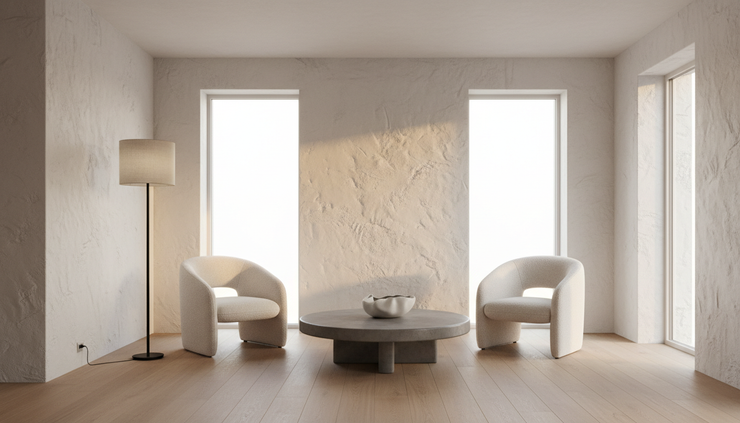
A coffee table in a room creates paths. People step around it, lean across it, place objects on it, gather near it, or avoid it. Its height and mass decide whether a room feels open or anchored. Its surface decides whether it invites use or forbids it.
The same is true for lighting. Light is not just visibility. It is direction, mood, attention, and time. A lamp can make a space feel early morning or late evening. It can make a wall recede or make a material glow. It can turn a corner into a place.
The physical object becomes a keeper of atmosphere.
Good design controls pace
Much of modern life pushes speed. High-end design can do the opposite. It can slow behaviour in useful ways.
A heavy door teaches transition. A finely balanced chair encourages settling. A manual object can restore attention to action. A textured surface can pull the eye away from the screen and back into the room.
This is not nostalgia. It’s a defence of perception.
When every object aims for instant response, the body loses meaningful friction. The world becomes shallow. The best product design returns depth to ordinary actions. It gives the hand something to know. It gives the eye reason to stay.
That’s why design belongs in cultural conversation. It shapes daily time. It influences how people sit, gather, work, read, speak, rest, and look.
Industrial objects form habits. Habits form culture.
Fine art begins where use becomes unstable
The line between industrial design and fine art is not fixed. It moves with context, intention, rarity, use, and perception.
A chair in a kitchen is furniture. The same chair on a plinth becomes an object of study. A lamp in use gives light. A lamp in a gallery may function as sculpture, drawing, atmosphere, and machine at once. A vessel may hold water, or it may hold an idea of containment.
The crossing point appears when utility no longer exhausts meaning.
Functional art lives in this tension. It can be used, but use is not the whole event. It carries a formal argument. It asks to be read through line, volume, surface, reference, and presence.
This can create conflict. If a chair is too rare to sit on, is it still a chair? If a table’s surface can’t accept a cup, is it still a table? If an object keeps its functional name while refusing normal use, is that failure or critique?
There’s no single answer. The strength lies in the pressure of the question.
The plinth changes everything
Context changes behaviour.
Place an industrial object in a gallery and the viewer slows down. The eye moves over seams, proportions, shadows, joins, and material transitions. The object no longer disappears into use. It becomes visible as thought.
This shift can reveal intelligence that daily life hides. It can also expose weakness. Some objects only work as images. They collapse when judged by touch, balance, and use. Others become richer when isolated because their formal discipline becomes clear.
A strong designed object survives both conditions. It can serve a body and hold a room. It can be used without losing presence. It can be displayed without becoming empty.
Collectors and curators often understand this better than the wider market. They know that an object can belong to several histories at once. It can belong to craft, sculpture, industrial production, domestic ritual, and architectural space.
This layered status gives high-end design its cultural force.
Edition, authorship, and aura matter
Fine art has long dealt with questions of authorship, edition, and aura. High-end design shares those questions in its own way.
A mass-produced chair can have enormous cultural importance. A limited piece can have little value beyond scarcity. A handmade object can carry the trace of its maker. An industrial object can carry the ethics of system, repeatability, and access.
None of these categories guarantees quality.
What matters is whether the object creates a clear and lasting encounter.
Edition can affect that encounter. A unique work may ask for attention through singularity. An editioned design piece may balance repeatability with care. A widely available object may gain force through collective memory, because many bodies have known it over time.
Authorship also matters, but not as celebrity. It matters because strong design reveals decisions. It shows a mind at work. It shows judgement in restraint, proportion, material, and use.
Aura, in design, often comes from this meeting of precision and life. The object feels resolved, but not dead. It feels complete, but open to use.
When use becomes ritual
The strongest bridge between design and art is ritual.
A ritual is not always religious or formal. It can be the way someone lights a lamp at dusk, pours tea, opens a cabinet, unfolds a chair, sharpens a pencil, or sits to read.
High-end product design can turn ordinary gestures into acts of attention. This is where its philosophical force becomes clear. It doesn’t need to leave the home for the gallery. It can work in private, every day, through repetition.
A sculptural object may challenge perception once. A functional object can challenge perception repeatedly. It can reshape the everyday from within.
That makes product design powerful. It enters life by consent. It doesn’t demand contemplation, yet rewards it. It doesn’t reject use, yet exceeds it.
Fine art and industrial design meet most fruitfully when neither one pretends to be the other. The designed object should not abandon the body too quickly. The art object should not be reduced to function. The charged space lies between them.
In that space, a chair can be a proposition. A lamp can be a drawing in light. A table can be a social instrument. A vessel can become a study of emptiness. A handle can become a theory of touch.
The future belongs to objects with depth
High-end product design has no reason to choose between comfort and thought. The best work proves that ergonomic clarity and aesthetic philosophy can strengthen each other.
The body needs support. The eye needs tension. The hand needs honesty. The room needs rhythm. The planet needs restraint. Culture needs objects that carry memory rather than consume attention for a season.
Form no longer follows function in a simple line. It follows perception, use, material life, and spatial consequence. It follows what the object asks the body to do and what it teaches the mind to notice.
The future of high-end design won’t be defined by louder forms or rarer materials. It will be defined by objects that justify their presence. Objects that work well, age well, and think clearly.
A great object doesn’t end at utility. It changes the terms of attention.


Comments