


Wearable Concepts Textile Art and Avant Garde Fashion

A garment can hold space the way sculpture does. It can frame the body, resist it, hide it, extend it, or turn it into a moving surface for ideas.
That’s why the strongest work in textile art and avant-garde fashion doesn’t sit neatly under “clothing”. It belongs to a wider field of form, touch, memory, identity, labour, technology, and cultural critique. It asks what a body carries before it says what a body wears.

Textiles work as structural and tactile art media
Textile is never passive. It bends, pulls, folds, frays, wraps, absorbs, and remembers pressure. These qualities make it one of the most direct materials for thinking through the body.
Stone and bronze hold mass. Paint holds image. Textile holds contact.
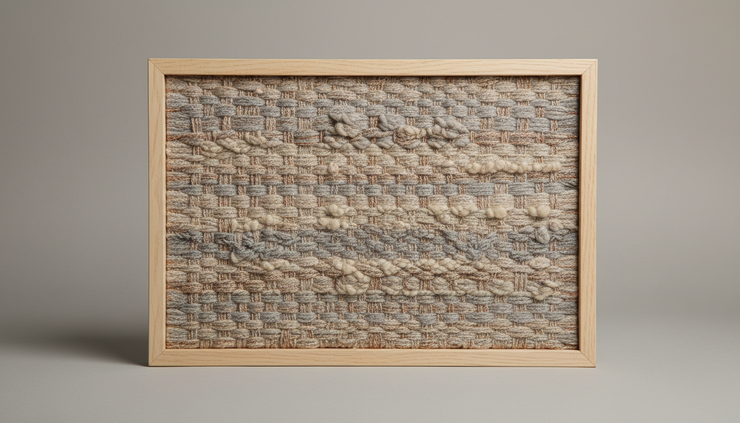
A woven surface records the logic of its making. Warp and weft cross under tension. A felted form shows compression. Knotted fibre carries rhythm and repetition. Pleated fabric stores movement before the body even enters it. When cloth becomes sculptural, it doesn’t lose softness. It gains authority.
This is central to wearable textile art. The body becomes a support, but not a neutral one. It breathes, sweats, bends, ages, and changes the work each time it moves. A textile object on a wall holds one kind of presence. A textile object worn on the body becomes unstable, theatrical, and alive.
The history of modern textile art already gives us the foundation. Anni Albers treated weaving as a serious modern art form at the Bauhaus and later in the United States. She wrote about the “event of a thread”, a phrase that still matters because it treats material as action, not decoration. Sheila Hicks pushed fibre into colour, density, and spatial force. Magdalena Abakanowicz made large woven forms that felt like skins, shelters, and bodies at once.
These artists helped move textile away from the narrow category of craft. They showed that fibre could carry weight, scale, and intellectual force. Fashion took a parallel route. When designers build garments that alter shape, posture, or speed, they also work like sculptors.
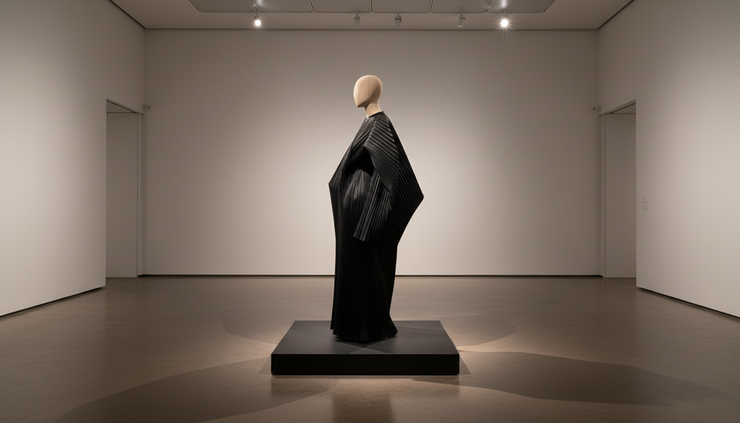
Think of pleats that open and close like engineered paper. Think of felted wool that stands away from the shoulder. Think of a dress that doesn’t follow the waist, but builds an oval, a shell, or a second spine. These are not styling gestures. They are spatial claims.
Cloth can make the body more visible. It can also make the body strange.
That tension gives textile its power. It belongs to skin and shelter at the same time. It can suggest intimacy, ritual, labour, protection, class, gender, and ceremony without spelling them out. A woven object doesn’t need to depict a body to carry bodily knowledge.
Structure starts with tension
Textile structure depends on force. Threads must be pulled into relation. A garment must manage gravity. A sleeve must decide how much freedom the arm has. A train must decide whether the wearer glides or drags.
This makes textile art close to architecture. Both deal with load, surface, scale, and human movement. The difference is that textile can also collapse. It can be folded into a drawer, packed into a trunk, or held in the hand. Its strength often comes from that contradiction.
A rigid sculpture says, “I occupy this space.”
A textile sculpture says, “I can occupy this space, then change.”
That is why textile is such a sharp medium for ideas about time. Fabric fades, creases, stains, and wears down. It registers touch. It can show duration more intimately than marble or steel. A garment made for performance carries the trace of every action. It becomes an archive of movement.
Touch is part of the meaning
Textile art also works through desire. People want to touch it. Even in a museum, where touching is usually forbidden, cloth produces a haptic response. The eye imagines texture. The body completes the viewing.
This matters for contemporary art. Much of visual culture now arrives through screens. Textile refuses that flatness. It asks for scale, nearness, tactility, and bodily memory. It reminds us that images are not enough.
A rough fibre surface can point to labour. A sheer fabric can speak about exposure. A heavy felt can read as burden. A metallic thread can suggest armour, value, or ritual. These meanings come through material before language.
That’s the base of conceptual textile design: material logic becomes meaning.
Avant-garde fashion critiques identity and future culture
Avant-garde fashion is often described as extreme. That reading is too simple. Its real force lies in critique.
It uses garments to ask direct questions:
What counts as a body?
Who gets to be seen?
What does power look like when it is worn?
How much of identity is chosen, imposed, or performed?
What kind of future is being designed through appearance?
Fashion sits close to the social surface. It knows how identity gets read quickly. Clothes signal class, gender, belief, work, wealth, rebellion, grief, and belonging. Avant-garde fashion takes that fast-reading system and breaks it open.
It changes proportion. It covers the face. It distorts the hip, shoulder, back, or head. It rejects the polished body. It uses decay, padding, asymmetry, hardness, transparency, or restriction. Each move questions the normalised body and the social rules around it.
Rei Kawakubo’s 1997 collection, widely known as Body Meets Dress, Dress Meets Body, remains a key example. The garments placed padded forms in unexpected areas across the body. The effect was not simply “unflattering”, which is a weak way to read it. The work questioned the idea that clothing should confirm a narrow ideal body. It turned distortion into thought.
Alexander McQueen used tailoring, theatre, and historical reference to stage beauty beside violence, memory, nature, and power. Hussein Chalayan connected garments to migration, furniture, technology, and political displacement. Iris van Herpen has built dresses that appear to hover between anatomy, water, microstructure, and air.
These designers differ in method. The shared point is clear. Fashion can produce philosophy through form.

The body becomes a site of argument
High fashion can make the body look less familiar. That is its intellectual strength.
The conventional garment flatters, fits, and supports a recognised role. The avant-garde garment interrupts that role. It may make walking slower. It may hide the face. It may create volume where culture expects narrowness. It may deny symmetry. It may ask the wearer to become image, architecture, creature, relic, or signal.
This is where avant-garde fashion critique becomes valuable. It doesn’t only criticise from outside culture. It uses culture’s own visual language, then bends it.
A sharply cut black coat can carry discipline and authority. A torn textile can carry damage, poverty, protest, or ritual, depending on context. A garment that fuses human and animal reference can question the boundary between bodies and species. A dress that looks grown rather than sewn can propose a future culture less centred on extraction and waste.
That last point matters now. Fashion is tied to production, consumption, and environmental harm. Avant-garde work cannot solve those problems by image alone. But it can help change the cultural imagination around clothing. It can make slowness, repair, biomaterials, and durability visible. It can make waste look unacceptable rather than normal.
Identity is not fixed in cloth
Clothing has always built identity. Uniforms create order. Ceremonial dress creates continuity. Subcultural dress creates belonging and resistance. Religious textiles can carry devotion. Mourning clothes carry social codes around loss.
Avant-garde fashion enters this history and unsettles it.
It rejects the idea that identity sits neatly on the body. Instead, it presents identity as layered, performed, inherited, and unstable. A garment can show that a self is built from memory, pressure, fantasy, and social demand.
This is why masks, veils, layers, exaggerated silhouettes, and strange textures keep returning in high-concept fashion. They are not only visual effects. They deal with visibility. They ask when exposure becomes control, and when concealment becomes freedom.
The future enters here too. Contemporary culture already changes the body through screens, filters, data, surgery, sensors, and synthetic materials. Avant-garde fashion gives those changes form before they become normal. It can imagine bodies that are extended, protected, coded, or partially hidden from systems of recognition.
That makes fashion as fine art a serious category, not a provocation. The garment becomes a frame for present anxieties and future habits.
Traditional weaving now meets smart and bio-based fabrics
The future of textile art won’t be purely digital. It will be woven, grown, repaired, coded, and remembered.
Traditional techniques still matter because they contain deep material intelligence. Weaving, knitting, felting, embroidery, lace-making, dyeing, and quilting all manage structure through repetition and variation. They also carry local histories, gendered labour histories, trade routes, and ritual knowledge.
New materials add a different set of questions. Conductive threads can carry low electrical signals. Bio-based fabrics can come from plant fibres, agricultural waste, or lab-grown processes. Some experimental textiles respond to heat, light, moisture, or movement. Others aim to reduce dependence on petroleum-based synthetics.
The strongest work does not treat technology as spectacle. It treats it as another thread in the argument.
A woven textile with conductive yarns can make contact visible. A garment made from mycelium-based material can challenge the idea that luxury must rely on animal skin or extractive processes. A naturally dyed cloth can place colour back into relation with soil, season, and plant knowledge. A bio-based fibre can ask what it means for a garment to return to the earth.
These are not minor material choices. They shape the ethics and meaning of the work.
Old techniques are not nostalgic
Weaving is often misread as old-fashioned. That misses the point. A loom is a system for organising information through threads. Pattern, tension, sequence, and repeat all matter. Long before digital culture, weaving already understood code in material form.
This isn’t a metaphor stretched too far. The Jacquard loom, developed in the early nineteenth century, used punched cards to control woven patterns. That method later became part of the historical conversation around automated information systems. Textile and computation have been linked for a long time.
That history gives contemporary artists and designers rich ground. They can connect hand skill to machine logic without flattening either one. A handwoven smart textile can show both human rhythm and technical response. A digitally guided loom can still produce work that depends on fibre behaviour, touch, and judgement.
The best pieces keep the hand present.
A perfect surface may impress. A surface with slight variation can speak. It records decisions, hesitations, repairs, and pressure. In a fine art context, that record matters.
Bio-based materials change the narrative
Bio-based fabrics are not automatically ethical. Their value depends on how they are sourced, processed, dyed, transported, and used. Still, they open vital questions for artists and designers.
They shift the story from extraction towards cultivation. They make decay part of the design conversation. They question permanence as the highest artistic value.
Museums and collectors have long prized durability. Textile challenges that bias. Many fibres are sensitive to light, humidity, insects, and handling. Smart or bio-based textiles can be even more complex to preserve. That fragility is not a weakness by default. It can be part of the work’s meaning.
A garment that changes over time may be closer to performance than monument. A material that cracks, dries, or softens may carry the idea of life cycle. That doesn’t excuse poor making. It asks for clearer thinking about what conservation should protect: the original matter, the artist’s process, the visible form, or the concept.
Smart cloth should serve the concept
Responsive textiles can easily become gimmicks. A dress that lights up is not automatically profound. A sensor hidden in cloth does not create meaning by itself.
The question is always simple: what does the material do for the idea?
If a garment reacts to breath, it can speak about vulnerability. If it changes shape with heat, it can address climate, intimacy, or the instability of the body. If it records movement, it can turn performance into trace. If it uses biodegradable material, it can hold a direct conversation with mortality and waste.
Material narrative matters because it keeps the object honest. Form, process, and idea must reinforce each other.
This is where craft knowledge becomes essential. A smart textile still has to drape, stretch, resist, and survive handling. A bio-based material still has smell, grain, thickness, and edge behaviour. The future of fashion will not be built by ignoring textile knowledge. It will be built by respecting it.
Museums are giving wearable art more serious space
Wearable art has moved from the runway and studio into major museum galleries. That shift has been building for decades, and it’s now impossible to ignore.
The Metropolitan Museum of Art’s Costume Institute has played a major role in placing fashion within art historical debate. The Victoria and Albert Museum in London has long treated dress as a key part of material culture. Exhibitions on designers such as Alexander McQueen, Christian Dior, and Gabrielle Chanel have drawn broad audiences while also raising serious curatorial questions about authorship, craft, spectacle, and commerce.
The museum context changes how garments are read. On a runway, a garment is time-based. It appears, moves, and disappears. In a gallery, it slows down. It becomes object, document, sculpture, and evidence.
This shift has benefits and risks.
The benefit is attention. Viewers can see construction, silhouette, surface, and reference more carefully. Curators can place garments beside painting, sculpture, photography, film, and archival material. Fashion enters the conversation where it belongs: inside visual culture, not beside it.
The risk is loss of movement. A garment on a mannequin can become frozen. The living body vanishes. Scale changes. The sound of fabric, the pace of walking, and the charge of performance become hard to recover.
Good exhibitions address this directly. They use film, sketches, samples, installation, lighting, and spacing to restore context without turning the gallery into a shop window. They show process as well as finish. They treat the garment as an artwork with a life before and after display.
Conservation now has harder questions
Museums know how to preserve oil paint, stone, paper, and metal, though each has its own problems. Wearable textile art brings different pressures.
Textiles are vulnerable. Light can fade dyes. Gravity can distort fabric. Old fibres can split. Plastics may degrade. Adhesives can fail. Smart fabrics may contain parts that stop working. Bio-based materials may age in ways that are hard to predict.
This creates serious curatorial decisions.
Should a garment be displayed flat or on a form? Should a replica be used for performance? Should electronic parts be replaced if they fail? If a material was designed to decay, should the museum slow that decay or allow it? If an artwork depends on being worn, can it still be fully itself behind glass?
There is no single answer. The point is that wearable art forces museums to confront time more honestly. It makes ageing visible. It turns conservation into interpretation.
The gallery gives fashion a slower language
Museum display can free fashion from seasonal pressure. It allows garments to be read across decades and cultures. A visitor can see how a sixteenth-century ruff, a Japanese kimono, a Bauhaus textile, a punk garment, and a contemporary sculptural dress all manage body, rule, and surface.
That broad frame matters. It resists the idea that fashion is only novelty. It shows continuity and rupture.
It also helps collectors read garments with more care. Provenance, condition, material stability, edition status, designer archive, exhibition history, and documentation all shape value. For wearable art, documentation can be especially important. Photographs, film, sketches, fitting notes, and performance records may carry part of the work’s meaning.
The gallery does not make fashion serious. The best fashion was already serious. The gallery gives it the conditions to be studied as form, thought, and cultural evidence.
Wearable art changes how we define sculpture
Sculpture no longer needs to stay still. It can be worn. It can fold. It can pass through a doorway. It can respond to weather, breath, and touch. It can enter a room with a body and leave with it.
This is not a dilution of sculpture. It is an expansion.
Wearable forms make space social. They change how close people stand. They alter how a wearer moves through architecture. They direct attention. They can protect, expose, restrict, or exaggerate. They operate in real time.
That makes them ideal for thinking about space-time in visual culture. A static object often asks us to move around it. A wearable object moves through the world and changes as it goes. The artwork is not only the form. It is the form across duration.
This also connects wearable art to painting. At first, the link may look weak. Painting is flat. Clothing is dimensional. Yet both deal with surface, composition, colour, gesture, and the frame.
A painted canvas holds pictorial space. A garment holds bodily space. A brushstroke records movement of the hand. A seam records movement of the maker. A painted figure can construct identity through pose and costume. A sculptural garment can turn identity into the whole field of the work.
Modern visual culture has blurred these categories for good reason. Artists now work across image, object, performance, and installation. Textile sits comfortably in that expanded field because it has always crossed boundaries. It is domestic and public. Useful and symbolic. Fragile and strong. Intimate and monumental.
The market is learning to read textile intelligence
Collectors once treated fashion and textile as secondary to painting and sculpture. That hierarchy has weakened. It has not vanished, but it is no longer secure.
Several forces have changed the picture.
Major museum exhibitions have trained public attention. Academic study has deepened the language around dress and fibre. Artists have pushed textile into large-scale installation and performance. Younger collectors often show fewer anxieties about old divisions between art, design, fashion, and craft.
Still, careful reading matters.
A wearable artwork should not be judged only by visual impact. It needs material intelligence. It needs conceptual force. It needs a clear relationship between body, technique, and idea.
Strong works often show these qualities:
Structural clarity The form has an internal logic. Volume, seam, weave, and support all serve the work.
Material necessity The chosen fibre, fabric, or process carries meaning. It is not interchangeable.
Bodily consequence The work changes posture, movement, visibility, or relation to space.
Conceptual precision The idea is present in the object, not only in the wall text.
Documented life Records of performance, display, making, or provenance help preserve the work’s full meaning.
For curators, the challenge is similar. Wearable art needs room to breathe. It needs good light, but not too much light. It needs context, but not over-explanation. It needs to be seen as object and event.
The most persuasive displays avoid treating garments as celebrity relics. They focus on construction, thought, and cultural charge.
The future will be grown, woven, worn, and collected
The next phase of textile art and avant-garde fashion will not follow one clean path. It will move in several directions at once.
Some artists will return to hand processes with new seriousness. Slow weaving, natural dyeing, repair, and regional fibre knowledge will gain force as cultural memory and ecological response. Some designers will work with responsive textiles and bio-based materials. Some will make garments that are never meant for daily wear, but operate as sculpture, performance, and proposition. Some will build archives rather than collections in the commercial sense.
The strongest work will not worship the future. It will question it.
A smart fabric can still repeat old power structures. A bio-based material can still become luxury theatre. A handwoven garment can still ignore the labour histories it draws from. Serious work must face these tensions directly.
That is where the field becomes exciting. Textile art and avant-garde fashion sit at the crossing of body, time, surface, technology, and belief. They make abstract ideas physical. They turn identity into structure. They turn fabric into argument.
Wearable concepts matter because they refuse the old split between thinking and making. They show that touch can be rigorous. They show that softness can carry authority. They show that a garment can be a sculpture, a text, a performance, and a forecast.
The body is not a distraction from the artwork. It is the site where the artwork begins.


Comments